Time Blindness in ADHD: Why You Can't 'Just Plan Better'
Time blindness is not a metaphor. For millions of adults with ADHD, the brain's internal clock is genuinely, measurably different. This guide explains what that means, why trying harder does not fix it, and what actually does.
This article draws on peer-reviewed ADHD research and clinical frameworks. It is not medical advice. If you suspect you have ADHD, speak with a qualified clinician.
"It's 9:47 and you said you'd leave at 9:30"
You know this scene. You sat down to send one email before leaving. The email became three replies. Somewhere in there, you followed a link, remembered a task you'd been meaning to do for weeks, and started it. You look up and forty-five minutes have passed. You have no idea where they went. From inside the experience, it felt like ten minutes at most.
Or the other version: a deadline has existed on your calendar for three weeks. You have thought about it. You have not avoided it deliberately. But it lived somewhere in the future, unthreatening and abstract, right up until it was suddenly this afternoon. The rational part of your brain knew the date. The rest of your brain did not feel it coming.
These are not failures of character. They are not failures of planning. They are not even, strictly speaking, failures of effort. They are the signature of a brain that perceives time differently from the majority of brains around it. ADHD researchers call this time blindness, and it has a measurable neurological basis.
The people around you who are reliably on time are not working harder than you. They are running on an internal clock that yours does not replicate. They feel time passing. For many ADHD brains, time does not pass. It lurches. You are either in the present moment or you are nowhere near the future, regardless of how many alarms you set.
Understanding this is not an excuse. It is the starting point for doing something that actually works. Most time-management advice is designed for brains that can already feel time. If yours cannot, the advice does not apply. What applies is a different set of tools entirely, and they work not because they change your brain but because they do the time-sensing your brain cannot do for itself.
What time blindness actually is

Time blindness is the neurobiological difficulty in sensing the passage of time and in projecting forward to estimate how long things will take or how soon a deadline is. The term was popularised by Russell Barkley, one of the most cited researchers in executive function and ADHD, who argues it is one of the most fundamental and least discussed aspects of the condition (Barkley, 2012).
Most brains have a background process running continuously: a rough, embodied sense of how much time has elapsed since the last reference point. This is not conscious mental arithmetic. It is more like a felt sense, similar to proprioception (the body's sense of where its limbs are in space). It runs passively, without effort, and most people do not notice it because it has never failed them in a dramatic way.
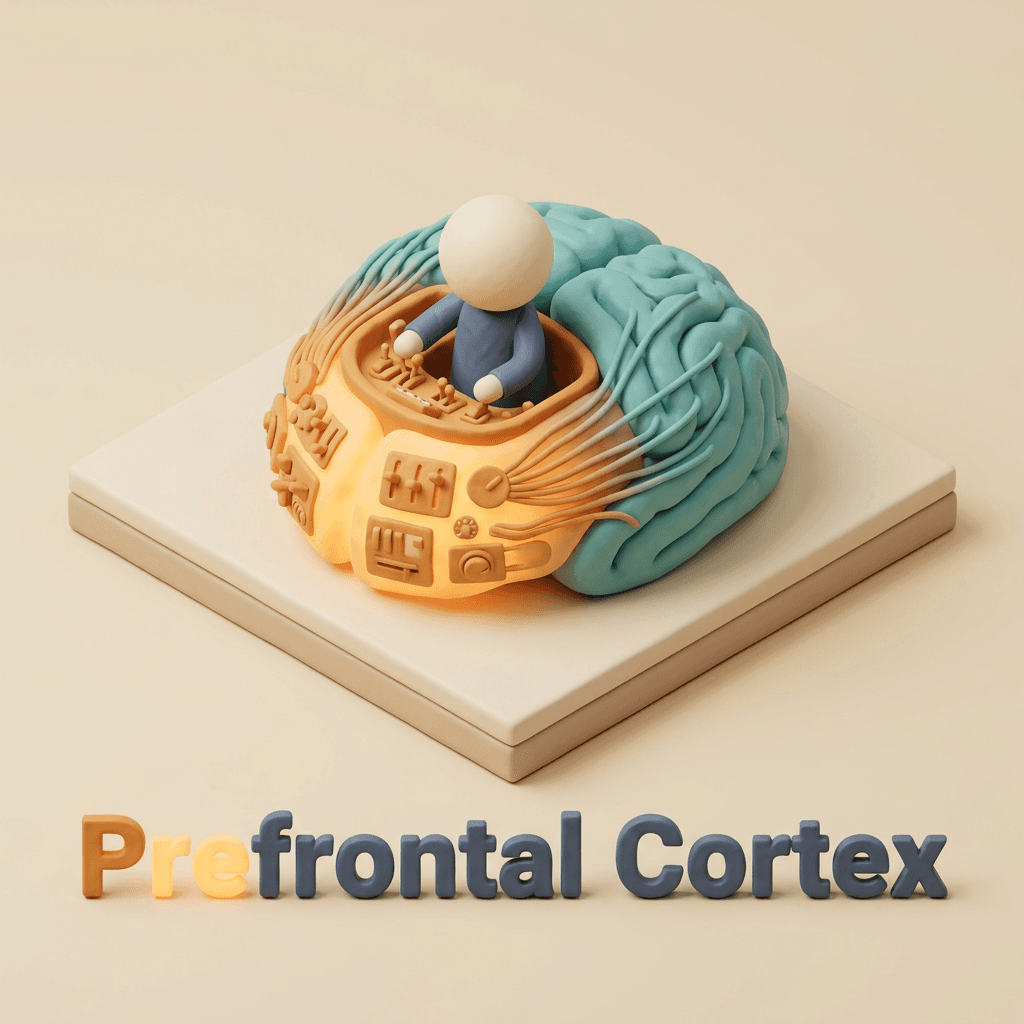
In ADHD, this system is less reliable. Brain-imaging studies have found reduced activation in the cerebellum and prefrontal cortex during temporal estimation tasks in adults with ADHD. The cerebellum, long understood as a motor coordination structure, is now known to play a role in timing; the prefrontal cortex is central to the working memory and prospective thinking that any estimate of future time requires. Noreika et al (2013) reviewed 41 studies of time perception across ADHD and found consistent evidence of impaired duration discrimination across age groups.
This is not about intelligence. Many people with ADHD have high analytical intelligence and can reason about time perfectly well in the abstract. The difficulty is with the felt, continuous, passive sense of duration. Knowing that the meeting starts in twenty minutes and feeling that the meeting starts in twenty minutes are two entirely different things for an ADHD brain (Faraone et al, 2019).
Two flavours of time blindness
Time blindness shows up in two overlapping but distinct ways. Understanding which one is most active for you helps in choosing the right scaffolds.
'Now versus not now'
For many ADHD brains, time collapses into two zones: right now, and not yet. Anything that exists in the future zone loses its emotional weight, regardless of how rationally important it is. The dentist appointment in three weeks registers as "not now", with roughly the same felt urgency as an appointment in three years. This is why ADHD adults often describe knowing a deadline was coming and genuinely not feeling any pressure about it until it was suddenly the morning of. It is not self-deception. The future simply does not feel real until it becomes the present.
Time-estimation bias
Even when ADHD brains do think about future tasks, the estimates are reliably skewed. Neurotypical adults tend to underestimate task duration slightly, a well-documented cognitive bias. ADHD adults do the same, but at a larger scale: underestimating how long a task will take, and overestimating how much time remains before it needs to start. The result is the familiar sequence of "I have plenty of time" followed by "how did this happen again?" Noreika et al (2013) found that ADHD adults made errors of estimation roughly 50% larger than control participants on intervals over 30 seconds.
Why willpower does not fix it

The standard advice for chronic lateness is a variation on: plan better, leave earlier, set more alarms, take it seriously. This advice assumes a brain that can feel time passing and simply needs better decisions at key moments. For most ADHD brains, that assumption is incorrect.
Adding more internal effort to a system the brain is biologically not built for does not produce punctuality. It produces shame. The ADHD adult who has tried every planner, every app, every productivity system, and still cannot make it work is not failing from lack of motivation. They are applying a motivational solution to a structural problem.
This matters because the shame generated by repeated failure at time management is itself disabling. Many ADHD adults carry years or decades of accumulated evidence that they are irresponsible or unreliable, evidence that accumulated not from bad character but from trying to run on an internal clock that was not installed (Barkley, 2012).
The fix is structural, not motivational. The goal is not to improve how hard you try to sense time. It is to add external systems that do the sensing for you and make the results impossible to ignore.
Ready to explore further?
Take a free screening, chat with Sheldon, or explore 30+ neurotypes in depth.
What actually helps

The scaffolds below work because they externalise the time-sensing function the ADHD brain cannot perform reliably on its own. They do not fix the underlying neurology. They route around it.
Externalise time visibly
Digital clocks display data. An analogue clock displays passing. The sweeping second hand and the visible arc of the hour hand give the ADHD brain a spatial representation of time that a set of numbers cannot. Time Timers (physical and app-based) go further: they show time as a disappearing coloured disc, so the amount of time remaining has a literal visual presence. See our time-blindness toolkit for specific tools.
Implementation intentions
Abstract intentions ("I will leave at 9:30") require the brain to monitor the passage of time and then trigger the action. Specific if-then formulas bypass this: "When the kettle boils, I put on my shoes." "When this song ends, I close the laptop." The trigger is perceptual and immediate, not time-dependent. The ADHD brain can respond to a sensory event far more reliably than to a time of day.
Externalise deadlines
Shared calendars with colleagues, visible Kanban boards on the wall, and accountability partnerships all move the deadline out of your head and into the environment. The goal is to make the deadline something you encounter repeatedly, not something you hold in working memory and then forget to feel. Physical Kanban boards work better than digital ones for many ADHD adults because they exist in the same physical space where work happens.
Buffer engineering
If you think you have plenty of time, act as if you have half as much. Budget twice your initial estimate for any task. Plan to arrive thirty minutes before the time you actually need to be there. Build buffers into buffers. This is not pessimism about yourself; it is calibration for a known and stable bias. Once you know your time estimates skew long, you can compensate mechanically without it being a judgment on your worth.
Body doubling
Working alongside another person, in person or via a silent video call, anchors the passage of time in a way that being alone often does not. The other person's presence provides a social and environmental reference point that helps the ADHD brain stay located in real time rather than in the timeless flow state that makes hours disappear. See body doubling for practical options.
Treatment
ADHD medication, particularly stimulant medication, is reported by many ADHD adults as substantially improving time perception subjectively, with research evidence supporting better time-estimation accuracy (Faraone et al, 2019). Medication addresses the neurological substrate, which means the scaffolds above may become less necessary or work better when combined with treatment. Medication is a clinical decision; scaffolds are available whether or not treatment is in place.
When time blindness becomes a relationship problem

Chronic lateness reads as "doesn't care" to a non-ADHD partner, family member, or colleague. The person who is always waiting has accumulated evidence, over months or years, that their time is not valued. The ADHD person, meanwhile, experiences themselves as someone who is always failing despite genuine effort. Both interpretations are coherent from the inside. Neither describes what is actually happening.
Naming the neurology does not excuse the impact on others. Chronic lateness still has costs. But it does shift the conversation from "do you even care?" to "this is a perceptual difference, and here is what we can change structurally to make it better." That shift de-escalates the spiral of shame and resentment that builds when both parties are interpreting the lateness as a moral statement.
Many couples and working relationships describe the introduction of external scaffolds (visible shared calendars, agreed buffer times, body-doubling practices) as more effective than any number of conversations about effort and consideration. The problem was structural; the fix needed to be structural too.
Frequently Asked Questions
What is time blindness in ADHD?
Time blindness is the difficulty many ADHD adults have in sensing the passage of time and in accurately estimating how long tasks will take. It is a neurobiological difference, not a character flaw, with measurable differences in brain regions involved in temporal cognition (Noreika et al, 2013).
Is time blindness a real diagnosis?
Time blindness is not a separate diagnosis in DSM-5-TR or ICD-11. It is a clinical descriptor used by Russell Barkley and other ADHD specialists for one of the most consistent features of adult ADHD. It maps closely to the executive-function difficulty with temporal cognition that the formal criteria capture indirectly.
Why do I always underestimate how long things will take?
ADHD brains consistently underestimate task duration, sometimes called the planning fallacy on steroids. The combination of weaker working memory, optimistic dopamine prediction, and reduced ability to project forward in time produces a stable bias. Knowing about the bias helps; doubling your initial time estimate is a useful rule of thumb.
Can medication help time blindness?
Many ADHD adults report substantial subjective improvement in time perception on stimulant medication, with research evidence supporting better time-estimation accuracy. Medication is one tool. External scaffolds (Time Timers, analogue clocks, body doubling, implementation intentions) help even without medication.
Why am I always late despite setting alarms?
Alarms work when the brain hears the alarm and translates it into "leave now". ADHD brains often hear the alarm and think "just one more email" or "plenty of time still". The alarm is a data point, not an action trigger. Tying tasks to perceptual triggers (when the kettle boils, when this song ends) is more effective for ADHD brains than abstract alarms.
Is time blindness the same as procrastination?
Related but distinct. Procrastination is delaying a task you know you should do. Time blindness is the inability to feel that the deadline is approaching until it is here. Many ADHD adults procrastinate because they genuinely do not feel the temporal pressure that motivates non-ADHD brains, until the deadline is suddenly "now", and panic-energy kicks in.
Will time blindness ever improve?
The underlying neurology stays. The daily impact often reduces dramatically with three things: external scaffolds (Time Timers, calendars, body doubling), treatment of the underlying ADHD, and self-compassion for the chronic lateness years. Many adults describe time blindness as the symptom that is most successfully managed once they stop trying to brute-force punctuality with willpower.
Start your journey with AskSheldon
Free tools to explore, screen, and understand your neurodivergent mind.
Built by neurodivergent minds. 30+ conditions explored. Always free.
Sources
- Barkley, R. A. (2012). Executive Functions: What They Are, How They Work, and Why They Evolved. Guilford Press.
- Noreika, V., Falter, C. M., and Rubia, K. (2013). Timing deficits in attention-deficit/hyperactivity disorder (ADHD): Evidence from neurocognitive and neuroimaging studies. Neuropsychologia, 51(2), 235-266.
- Faraone, S. V., Asherson, P., Banaschewski, T., Biederman, J., Buitelaar, J. K., Ramos-Quiroga, J. A., Rohde, L. A., Sonuga-Barke, E. J., Tannock, R., and Franke, B. (2019). Attention-deficit/hyperactivity disorder. Nature Reviews Disease Primers, 1, 15020.