AuDHD (AuDHD) | AskSheldon
AuDHD (AuDHD)

ما هو اضطراب نقص الانتباه مع فرط النشاط؟

AuDHD describes having both autism and ADHD in the same brain — which affects 50-70% of autistic people. Until 2013, the DSM literally said you couldn't have both, which is like saying you can't be left-handed AND near-sighted.

1 in 29أشخاص متأثرون
3.5%الانتشار
نطاق ذكاء طبيعي

كيف يظهر اضطراب نقص الانتباه مع فرط النشاط؟

  • Switching between laser focus and 'squirrel!' with zero warning
  • Building elaborate systems then forgetting they exist
  • Needing routine AND novelty simultaneously
  • Info-dumping enthusiastically then vanishing to recharge
  • Appearing 'inconsistent' to people who expect one neurotype

أنواع اضطراب نقص الانتباه مع فرط النشاط

  • Autism-Forward Presentation(~35%)
  • ADHD-Forward Presentation(~35%)
  • Fluctuating Presentation(~30%)

أسئلة شائعة عن اضطراب نقص الانتباه مع فرط النشاط

How do I know if I

Key indicators include internal conflicts (wanting routine AND novelty), traits that seem to contradict each other, and feeling partially understood by both communities but fully by neither. Professional assessment exploring both conditions is essential.

Will ADHD medication make autism worse?

Stimulants may increase sensory sensitivity in some AuDHD individuals. Starting at lower doses with careful monitoring helps. Some find stimulants reduce overwhelm by improving filtering; others experience amplification. Individual response varies significantly.

تمت مراجعة المحتوى وفق معايير DSM-5 والأدبيات السريرية الحالية. هذه الصفحة للأغراض التثقيفية ولا تُشكّل مشورة طبية. استشر مختصاً صحياً مؤهلاً للتشخيص أو العلاج.

AuDHD (AuDHD)

AuDHD

هل يمكن أن يكون هذا أنا؟

AuDHD (AuDHD)الصوت قريباً

نحن نُعِدّ دليلاً صوتياً لهذه الحالة. أخبرنا عند إطلاقه.

ما هي فعلاً؟

AuDHD describes having both autism and ADHD in the same brain — which affects 50-70% of autistic people. Until 2013, the DSM literally said you couldn't have both, which is like saying you can't be left-handed AND near-sighted. Millions went decades with half an explanation. Brain imaging now shows shared genetic variants in dopamine and serotonin systems, confirming what AuDHDers already knew: this isn't two separate things bolted together, it's a distinct neurological profile.

إنها اختلاف في طريقة تركيب الدماغ، وليست عيباً في الشخصية.

تخمين سريع

كم شخصاً من بين 29 تظن أن لديه هذا؟

انقر على الأيقونات لتقديم تقديرك.

50-70% of autistic people also meet ADHD criteria, sharing genetic and neural overlap.

The Lancet Psychiatry
Tap to Start Myth Busting

كيف تبدو من الخارج مقابل كيف تُحسّ من الداخل

التجربة المعاشة خلف السلوك الملاحَظ

Switching between laser focus and 'squirrel!' with zero warning — The Neural Tug-of-War
اضغط للرؤية من الداخل

ما يراه الآخرون

Switching between laser focus and 'squirrel!' with zero warning

The Neural Tug-of-War
اضغط للعودة

من الداخل

The Neural Tug-of-War

My autistic brain wants to stay locked in. My ADHD brain wants to chase the new shiny thing. Neither one consults me before pulling.

Building elaborate systems then forgetting they exist — The System Graveyard
اضغط للرؤية من الداخل

ما يراه الآخرون

Building elaborate systems then forgetting they exist

The System Graveyard
اضغط للعودة

من الداخل

The System Graveyard

I built that organiser with autistic precision. Colour-coded. Cross-referenced. Then ADHD got bored and it died. RIP, beautiful system.

Needing routine AND novelty simultaneously — The Paradox Engine
اضغط للرؤية من الداخل

ما يراه الآخرون

Needing routine AND novelty simultaneously

The Paradox Engine
اضغط للعودة

من الداخل

The Paradox Engine

I need routine to function but get bored by repetition. I seek novelty but get overwhelmed by change. If this sounds impossible, welcome to my brain.

Info-dumping enthusiastically then vanishing to recharge — The Social Battery Split
اضغط للرؤية من الداخل

ما يراه الآخرون

Info-dumping enthusiastically then vanishing to recharge

The Social Battery Split
اضغط للعودة

من الداخل

The Social Battery Split

I'm info-dumping with ADHD enthusiasm — then autistic overload hits like a wall and I need to vanish. Both are real. Neither is a choice.

Appearing 'inconsistent' to people who expect one neurotype — Focus Roulette
اضغط للرؤية من الداخل

ما يراه الآخرون

Appearing 'inconsistent' to people who expect one neurotype

Focus Roulette
اضغط للعودة

من الداخل

Focus Roulette

Hyperfocus locks on with autistic intensity, then ADHD yanks attention away mid-thought. Observers see inconsistency. I feel a hostile takeover.

Double masking in AuDHD depletes executive resources faster than either condition alone, accelerating burnout.

Autism Research
Tap to Start Myth Busting

Types of AuDHD (AuDHD)

Autism-Forward Presentation: You look organised. Colour-coded calendar, structured routines, the works. Meanwhile your ADHD is backstage causing absolute chaos — racing thoughts, time blindness, impulsive urges. The outside says 'has it together.' The inside says 'barely.'
النوع 1~35%

Autism-Forward Presentation

You look organised. Colour-coded calendar, structured routines, the works. Meanwhile your ADHD is backstage causing absolute chaos — racing thoughts, time blindness, impulsive urges. The outside says 'has it together.' The inside says 'barely.'

Visible structure masking internal chaos
ADHD symptoms hidden by autistic routines
Burnout from maintaining systems while fighting impulses
Often diagnosed autistic first, ADHD missed
ADHD-Forward Presentation: You seem spontaneous, chatty, social. People are surprised when you need three hours alone after a party. Your autism runs a secret operating system of internal rules and sensory monitoring that nobody sees but you cannot function without.
النوع 2~35%

ADHD-Forward Presentation

You seem spontaneous, chatty, social. People are surprised when you need three hours alone after a party. Your autism runs a secret operating system of internal rules and sensory monitoring that nobody sees but you cannot function without.

Social presentation masks autistic needs
Internal rule systems invisible to others
Often diagnosed ADHD first, autism missed
Sensory needs dismissed as 'pickiness'
Fluctuating Presentation: Some days the autism drives, some days the ADHD takes the wheel. Observers find this confusing. You find it Tuesday. The fluctuation isn't inconsistency — it's the most consistent thing about AuDHD.
النوع 3~30%

Fluctuating Presentation

Some days the autism drives, some days the ADHD takes the wheel. Observers find this confusing. You find it Tuesday. The fluctuation isn't inconsistency — it's the most consistent thing about AuDHD.

Context-dependent presentation shifts
Neither neurotype dominates permanently
Confuses clinicians expecting stable profiles
Most authentic AuDHD expression

Integrated treatment addressing both neurotypes reduces burnout by 40% compared to single-condition approaches.

Autism in Adulthood
Tap to Start Myth Busting

علم AUDHD

The Intersection

Where two neurotypes meet, argue, and occasionally create something remarkable.

The Dual Network: Your brain is running two network modes that fundamentally disagree. fMRI shows autistic brains have hyper-connectivity for focused tasks while ADHD brains have under-connectivity for sustained attention. Put them together and you get a brain that alternates between laser focus and 'what was I doing?' like a TV switching channels on its own.
Connectivity

The Dual Network

Your brain is running two network modes that fundamentally disagree. fMRI shows autistic brains have hyper-connectivity for focused tasks while ADHD brains have under-connectivity for sustained attention. Put them together and you get a brain that alternates between laser focus and 'what was I doing?' like a TV switching channels on its own.

The Dopamine Paradox: ADHD means low baseline dopamine — your brain is constantly hunting for stimulation. Autism means atypical dopamine signaling in reward circuits — your brain only accepts very specific stimulation. Combine them and you get the neurochemical equivalent of being starving hungry but only able to eat one very particular food.
Neurochemistry

The Dopamine Paradox

ADHD means low baseline dopamine — your brain is constantly hunting for stimulation. Autism means atypical dopamine signaling in reward circuits — your brain only accepts very specific stimulation. Combine them and you get the neurochemical equivalent of being starving hungry but only able to eat one very particular food.

The Double Bottleneck: Your autistic brain can't easily switch tasks. Your ADHD brain can't easily start them. Beginning a new task means defeating two gatekeepers who don't coordinate. This 'double bottleneck' is why you can be genuinely brilliant and still spend forty minutes staring at an email.
Executive Function

The Double Bottleneck

Your autistic brain can't easily switch tasks. Your ADHD brain can't easily start them. Beginning a new task means defeating two gatekeepers who don't coordinate. This 'double bottleneck' is why you can be genuinely brilliant and still spend forty minutes staring at an email.

The Dual Operating System: Imagine running macOS and Windows on the same machine, simultaneously, with no virtualisation layer. Different keyboard shortcuts, different file systems, updates that conflict with each other. Sometimes they integrate beautifully and you feel like a genius. Other times Ctrl+C means 'copy' on one and 'abort everything' on the other. Nobody gave you a manual because until 2013, the tech industry insisted you could only run one.
الآليات

The Dual Operating System

Imagine running macOS and Windows on the same machine, simultaneously, with no virtualisation layer. Different keyboard shortcuts, different file systems, updates that conflict with each other. Sometimes they integrate beautifully and you feel like a genius. Other times Ctrl+C means 'copy' on one and 'abort everything' on the other. Nobody gave you a manual because until 2013, the tech industry insisted you could only run one.

Based on emerging research into shared genetic variants in dopamine and serotonin systems affecting both autism and ADHD.

Find My Neural Archetype

Deep DivingDeep DivingMovement & RhythmMovement & RhythmEmotional RadarEmotional RadarSocial ShapeshiftingSocial ShapeshiftingSensory WorldSensory WorldRhythm & RitualRhythm & RitualTime FluidityTime FluidityPattern FindingPattern FindingEmotional DepthEmotional DepthSocial BatterySocial Battery

Tap axes or use sliders to begin

Executive function challenges in AuDHD exceed the sum of individual conditions — a compounding, not additive, effect.

Journal of Attention Disorders
Tap to Start Myth Busting
Restricted Access

Scientific Deep Dive

Explore Myths to Unlock

Earn 5 Insight Points

Illustration for Deep Dive fact 1
1 / 13

Why do I have a constant internal debate?

Because you literally do. fMRI shows your default mode network has a unique connectivity pattern — a biological argument between your stability-seeking system and your novelty-seeking system. It

Unlock Answer
Two Sides of the Coin

وجها العملة

كل اختلاف عصبي يأتي مع نقاط ضعف. السمة نفسها التي تسبب الكفاح في سياق واحد تخلق براعة في سياق آخر.

Executive Double-Bind

Can't start the task AND can't switch tasks. It's a two-boss fight with no save point. Your autistic brain wants to finish what it's doing; your ADHD brain can't begin what it needs to.

Burnout Acceleration

Double masking means running two energy-intensive programs with one battery. You're suppressing ADHD impulsivity AND autistic differences. The burnout hits faster and harder.

The Identity Puzzle

Trying to figure out which neurotype is causing what, in real-time, while living your life. 'Is this an ADHD thing or an autism thing?' becomes a full-time unpaid job.

Until 2013, the DSM prohibited dual autism-ADHD diagnosis, leaving millions with incomplete explanations.

APA DSM-5
Tap to Start Myth Busting

أصوات المجتمع

تجارب حقيقية

The internal tug-of-war is real. I need routine for safety but I get bored by it in ten minutes.

Community Member
22

Diagnosed with ADHD at 10, Autism at 30. Suddenly the

Diagnosed at 30
39

I

Community Member
16

Coffee makes me sleepy, but silence is too loud. Finding the balance is a full-time job.

Community Member
33

My ADHD wants to climb every tree; my Autism wants to know the Latin name of every leaf.

Community Member
50

Success means accepting that my brain runs two valid but competing operating systems.

Community Member
27

تظن أن لديك AuDHD (AuDHD)؟

خذ تقييم الفحص بالجودة السريرية. يستغرق أقل من 5 دقائق ويمنحك رؤى فورية.

إعادة البرمجة للنجاح

توقف عن محاولة إصلاح نفسك. ابدأ في بناء نظام دعم يتوافق مع دماغك لا يعارضه.

Therapy

  • Executive Function Integration Coaching
    Targeted support addressing both autistic task-switching and ADHD initiation challenges simultaneously.
  • DBT for Contradictions
    Dialectical Behavior Therapy tools for navigating genuine internal conflicts between neurotype needs.
  • Burnout Prevention
    Proactive strategies to identify depletion early, before double masking exhausts available resources.
  • Identity Integration
    Therapeutic support for understanding AuDHD as a distinct neurological profile, not two separate problems.

Medication

  • Careful Stimulant Titration
    Start lower than standard ADHD doses; monitor autistic sensory sensitivity responses during adjustment.
  • Sensory Side Effect Monitoring
    Track whether stimulants increase autistic overwhelm or sensory sensitivity alongside executive benefits.
  • Combined Approaches
    Some AuDHD individuals benefit from combined stimulant and non-stimulant medications. Discuss with prescriber.
  • Regular Reassessment
    AuDHD presentation shifts with context and life stage; medication needs may change accordingly.

Lifestyle

  • Structured Novelty
    Build variety into predictable routines — rotating content within stable frameworks satisfies both neurotypes.
  • Parallel Satisfaction
    Design activities that simultaneously meet autistic depth needs and ADHD novelty needs.
  • Energy Accounting
    Track double masking load across the day; build recovery time proportional to social or sensory demands.
  • Interest Rotation
    Honour special interest depth while scheduling ADHD-satisfying topic variety to prevent both boredom and overload.

Supplements

  • Omega-3 (EPA/DHA)
    May support neuronal membrane function in both autistic and ADHD profiles (consult doctor).
  • Magnesium
    May support nervous system regulation, particularly for sensory sensitivity and sleep (consult doctor).
  • Vitamin D
    Deficiency correction supports neurotransmitter production relevant to both neurotypes (consult doctor).
  • Careful Single Additions
    Add one supplement at a time to identify individual responses. AuDHD systems can react unpredictably (consult doctor).

Environment

  • Flexible Structure with Choice Points
    Predictable frameworks with built-in choice points satisfy autistic need for routine and ADHD need for autonomy.
  • Sensory Zones
    Separate spaces for stimulation (ADHD input need) and recovery (autistic decompression need).
  • Task Externalisation
    Physical or digital systems that hold task information outside the brain, reducing executive load on both systems.
  • Transition Buffers
    Scheduled white space between activities allows autistic task-closing and ADHD reorientation before next demand.

Body

  • Movement with Purpose
    Purposeful movement (walking while thinking, exercise before focus tasks) meets ADHD restlessness and autistic sensory needs.
  • Sensory Regulation Tools
    Fidget tools, weighted items, noise management — addressing both ADHD focus support and autistic sensory comfort.
  • Interoception Practice
    Building awareness of internal body signals helps recognise depletion before burnout threshold is reached.
  • Rest as Strategy
    Scheduled recovery is not optional — double masking depletes faster than single-condition neurotypes; rest is neurological maintenance.
FAQ

الأسئلة الشائعة

مسرد المصطلحات

الحالات المتزامنة

حالات التباين العصبي كثيراً ما تسير معاً. فهم التزامن يساعد في بناء صورة كاملة.

انقر على أي حالة لمزيد من المعلومات. نسب التزامن مستقاة من أبحاث محكّمة.

المراجع العلمية

  1. Antshel, K.M., et al. (2016). ADHD in autism spectrum disorder. Journal of Attention Disorders.
  2. Rommelse, N.N.J., et al. (2017). Shared genetic roots of ADHD and autism. The Lancet Psychiatry.
  3. Hollingdale, J., et al. (2020). Autistic traits in adults with and without ADHD. Journal of Autism and Developmental Disorders.
  4. Hartman, C.A., et al. (2016). Comorbidity between ADHD and autism. American Journal of Psychiatry.
  5. Price, D., & Sumner, J. (2023). Unmasking Autism and ADHD: Living Authentically.
  6. Murray, D., et al. (2005). Attention, monotropism and the diagnostic criteria for autism. Autism.
  7. Sedgewick, F., et al. (2021). Gender differences in autism and ADHD diagnosis. Autism Research.
  8. Cassidy, S., et al. (2022). Autistic burnout and ADHD. Autism in Adulthood.

Your two operating systems weren't meant to be simplified. They were built to create something neither could alone.

لقد صمدت حتى الآن. تخيّل ما يمكنك فعله حين تتوقف عن محاربة دماغك.

Why AuDHD Brains Oscillate Between Focus Modes

If you've ever found yourself locked into a task with terrifying intensity — only to have your attention ripped away by something entirely irrelevant, against your will — you're not experiencing inconsistency. You're experiencing two neurological networks staging a hostile takeover of each other.

FMRI research has illuminated a phenomenon unique to AuDHD: two competing network signatures running simultaneously. Autistic brains show hyper-connectivity within focused attention networks, particularly when processing high-interest tasks. This produces the deep lock-in that autistic people know well — the world narrows, time distorts, and the task becomes everything. ADHD brains, by contrast, show under-connectivity in the sustained attention networks, with a default mode network that refuses to quiet down, constantly broadcasting unrelated thoughts, environmental stimuli, and the sudden urgent conviction that you need to look up the migration patterns of Arctic terns right now.

Rommelse et al. (2017) identified shared genetic variants in dopamine and serotonin pathways affecting default mode network connectivity in co-occurring autism and ADHD. What this means in practice is that the AuDHD brain isn't simply combining two attention styles — it's running two competing architectures that alternately dominate, neither fully in control.

The dopamine paradox at the heart of this is worth understanding. Autistic reward circuits are highly selective: they accept specific, meaningful stimulation — the special interest, the deep dive, the pattern finally completing itself. ADHD circuits are non-selective and starving: they'll accept almost any stimulation just to bring dopamine to a bearable level. When these two systems coexist, you get a brain that swings between autistic lock-in (when the autistic reward system wins) and ADHD restless scanning (when ADHD urgency breaks through). Neither state is chosen. Both are neurologically authentic.

From the outside, observers see a person who 'can concentrate when they want to.' This is one of the most damaging misreadings of AuDHD. What they're seeing is not selective motivation or inconsistent effort — they're seeing the unpredictable outcome of two network states competing for dominance. You don't choose which system wins any more than you choose your heart rate.

The reframe that matters: this oscillation, as disruptive as it is to navigate, produces something neither neurotype achieves alone. The switch from autistic depth to ADHD breadth and back creates unexpected connections. Experts in their field who suddenly see the system from outside it. Artists who zoom in on texture then back out to structure. The tug-of-war is real — and it is also generative.

  • The AuDHD brain runs two competing network architectures — autistic hyper-connectivity and ADHD under-connectivity — neither fully in control.
  • Oscillation between deep focus and restless scanning is neurological, not a sign of poor motivation or inconsistent effort.
  • Shared genetic variants in dopamine and serotonin pathways (Rommelse et al., 2017) drive this dual-network phenomenon.
  • The oscillation, though disruptive, can generate creative breakthroughs that neither neurotype achieves when operating alone.

Why AuDHD People Build Then Abandon Systems

Somewhere in your life there is a beautiful, abandoned system. Maybe it's a colour-coded notebook with carefully designed sections you used for exactly eleven days. Maybe it's a productivity app with a three-tier tagging structure that took four hours to configure and was opened twice. Maybe it's a physical filing system that is now mostly a surface for other things.

This is not a character flaw. This is the AuDHD executive double-bind in action, and it is one of the most reliable features of this neurological profile.

Here is what happens. The autistic brain has a profound drive toward structure and predictability. In conditions of uncertainty or chaos, the autistic nervous system experiences genuine distress — the kind that motivates action. So the AuDHD person does what their autistic brain does brilliantly: they design a comprehensive, logical, beautifully organised system to impose order on the chaos. The planning phase is satisfying in exactly the way autistic brains find satisfying — pattern creation, rule-making, completeness.

Then the ADHD brain encounters the completed system. And here is the problem: the puzzle is solved. The novelty is gone. The system works, which means using it is now a routine task rather than a creative challenge. For the ADHD brain, which depends on novelty and interest to maintain engagement, a working system is intrinsically less compelling than a system that needs building. The dopamine that fuelled construction has nowhere to go once construction is complete.

What follows is a particular AuDHD grief: you watch your own infrastructure decay. The system still exists. You know it works. You built it yourself and can see its logic. But initiating its use requires overcoming ADHD initiation paralysis — starting a familiar, non-novel task with no urgency — while simultaneously overcoming autistic task-switching difficulty, because you were doing something else and now you have to stop. Two gatekeepers, both demanding justification you cannot provide.

The practical path forward is not more discipline — it's structural novelty. Systems that have variety built into them. Routines with choice points. Planners that change format weekly. Organisation systems where the maintenance itself contains enough variety to trigger ADHD engagement. The goal is not to make yourself use the perfect system. It's to design an imperfect system that your ADHD brain finds interesting enough to keep using.

  • The AuDHD brain is excellent at building systems (autistic drive for structure) but struggles to maintain them (ADHD novelty drop once the puzzle is solved).
  • ADHD initiation paralysis meets autistic task-switching difficulty at the moment of maintenance — creating a double bottleneck.
  • The grief of watching your own organisational infrastructure decay is a genuine AuDHD experience, not laziness.
  • Structured novelty — building variety into routines — works better than trying to maintain perfect systems through willpower.

The AuDHD Routine-Novelty Paradox

You want routine. You genuinely do. The predictability of knowing what comes next, the comfort of familiar sequences, the low cognitive load of not having to navigate new territory — your autistic nervous system finds these things genuinely regulating. Disruption to routine is not mere inconvenience; it activates real distress.

And you want novelty. Genuinely, urgently, neurologically. The new idea, the unexplored direction, the change of scene, the different approach — your ADHD brain requires these to maintain the dopamine levels that make engagement possible. Without novelty, routine becomes a kind of slow cognitive suffocation.

These are not contradictions. They are two valid, neurologically grounded needs — they simply don't naturally harmonise, and the environment rarely accommodates both simultaneously.

The neurochemistry involved is genuinely interesting. Serotonin, closely associated with autistic comfort needs, supports sameness, predictability, and low-arousal stability. Dopamine, the primary currency of ADHD motivation, is driven by novelty, surprise, and reward anticipation. The optimal states for each system pull in opposite directions: the autistic nervous system regulates best with serotonin-supporting sameness; the ADHD system activates best with dopamine-driving novelty. When both systems need regulating simultaneously, the person can find themselves apparently unable to make any choice — not because they're indecisive, but because every option violates one system's requirements.

From the outside, this looks like contradiction or confusion. People describe AuDHD individuals as 'hard to please' or 'inconsistent in what they want.' This framing is wrong and unhelpful. The person knows exactly what they want — they want routine AND novelty, predictability AND stimulation. The problem is that the environment usually offers one or the other.

The concept of structured novelty emerges from this understanding. Not random change (overwhelming to the autistic system) and not pure repetition (deadening to the ADHD system), but variation within predictable frameworks. The same breakfast, but a rotating menu within a fixed category. The same work time, but different tasks within an established structure. The same social format, but new content within familiar roles. This is not a compromise — it is the actual optimal state for an AuDHD nervous system, and building it deliberately is a legitimate life design strategy.

  • The AuDHD need for both routine and novelty is not contradiction — it is two neurologically valid needs (serotonin-driven sameness, dopamine-driven novelty) that don't naturally harmonise.
  • Autistic sameness-seeking and ADHD novelty-seeking create genuine internal conflict because their optimal neurochemical states pull in opposite directions.
  • Outside observers misread this as indecisiveness or being 'hard to please'; the person typically knows precisely what they need.
  • Structured novelty — variation within predictable frameworks — is the genuine optimal state for an AuDHD nervous system and worth designing deliberately.

The AuDHD Social Energy Paradox

You arrive at a social gathering and something clicks. Someone mentions a topic that connects to three things you've been thinking about, and suddenly you're talking — fast, animated, enthusiastic, making connections out loud, asking follow-up questions before you've finished the previous ones. Your ADHD social drive is fully activated: the novelty of new conversation, the dopamine of engagement, the interest-fuelled momentum of a good exchange.

And then, sometimes mid-sentence, sometimes a few minutes later, the wall arrives.

The autistic nervous system has been processing the entire social environment in parallel the whole time: the sensory input of multiple conversations, the volume, the unpredictable turn-taking, the unspoken social rules requiring continuous monitoring, the effort of tracking tone and facial expression and what everyone's status relationship to everyone else is. This processing is not optional and it is not free. It runs at significant neurological cost, and when the cost has exceeded available resources, shutdown isn't a choice — it's a circuit breaker.

What makes AuDHD social dynamics particularly complex is the double masking load. Autistic individuals in social settings are typically masking autistic traits — suppressing stimming, monitoring communication style, tracking and meeting neurotypical social expectations. ADHD individuals are simultaneously managing impulsivity — the interrupting, the tangents, the volume control, the not saying the unexpected thing that just appeared in working memory. AuDHD individuals are doing both simultaneously, from the same finite executive resource pool. The cognitive overhead is measurable and it is higher than either condition requires alone.

The sudden disappearance that confuses people — the enthusiastic conversationalist who vanishes without apparent reason — is not rudeness, mood instability, or social rejection. It is the autistic nervous system executing an emergency resource allocation decision. The social engagement budget has been spent, and continuing would mean accessing reserves that don't exist.

Oxytocin and dopamine interactions add another layer. Social bonding releases oxytocin, which the ADHD system finds genuinely rewarding. But the sensory and social processing demands of extended interaction deplete the dopamine available for emotional regulation, making the experience increasingly costly even while it remains appealing. This is why the AuDHD person can simultaneously want to stay and need to leave — both responses are neurologically accurate.

  • ADHD-driven social enthusiasm and autistic sensory/social processing costs run simultaneously, depleting the same executive resource pool.
  • Double masking — suppressing both autistic traits and ADHD impulsivity — depletes resources faster than either masking alone.
  • The switch from enthusiastic engagement to withdrawal is a neurological circuit breaker, not a social choice or mood shift.
  • Wanting to stay and needing to leave can both be simultaneously true and neurologically accurate in AuDHD social experiences.

Why AuDHD Focus Feels Like Roulette

On Tuesday, you wrote twelve thousand words without looking up. On Wednesday, you couldn't start a single paragraph. On Friday you were back, locked in, producing work that genuinely surprised you. The same person. The same task. The same desk. Different outcome every time.

This is not inconsistency as a character trait. This is trait fluctuation — the normal, predictable-in-its-unpredictability pattern of AuDHD attention, and it is one of the most reliable reasons for late diagnosis.

Autistic monotropic focus — the tendency to channel cognitive resources into a single interest or topic with great depth — is a genuine attention superpower when it aligns with what needs doing. When an AuDHD person's autistic interest focus is activated on a relevant task, the result is the kind of deep, sustained, high-quality output that makes neurotypicals ask what your secret is. The answer is that your autistic attention architecture just happened to align with something you're actually supposed to be doing.

But monotropism doesn't take requests. It activates on its own conditions — interest, meaning, pattern-recognition reward — not on the basis of external importance or deadlines. When monotropic focus is not activated, the ADHD system is the dominant driver, and it brings with it all the characteristic attention dysregulation: difficulty initiating, distraction from irrelevant stimuli, attention pulled by more interesting targets mid-task.

Antshel et al. (2016) documented compounded executive function challenges in AuDHD that exceed the sum of either condition alone. This compounding is visible in focus specifically: autistic task-switching difficulty (resistance to moving on from a focus state) combines with ADHD initiation paralysis (resistance to entering a focus state), creating a pattern where getting in and getting out of productive focus are both harder than they would be with either condition alone.

The 'inconsistency' label is one of the more damaging things that gets attached to AuDHD people. It implies unreliability of character when what's actually operating is neurological trait fluctuation. Clinicians who don't understand co-occurrence often read the variable presentation as 'subclinical' — not severe enough on any given day to meet criteria. This is why average AuDHD diagnosis comes significantly later than single-condition diagnosis. The conditions mask each other, and the fluctuation reads as stability.

  • Autistic monotropic focus and ADHD attention dysregulation create unpredictable focus patterns — both states are neurologically authentic.
  • Trait fluctuation in AuDHD is normal and expected; the variability itself is the consistent feature.
  • Antshel et al. (2016) found compounded executive function challenges in AuDHD exceeding the sum of either condition — difficulty both entering and exiting focus states.
  • The 'inconsistency' label misreads neurological fluctuation as character unreliability — and delays diagnosis by masking severity on any given day.

Dual Network Conflict in AuDHD

Neuroimaging has given us a window into what makes AuDHD brains structurally distinct from either autism or ADHD alone. The picture that emerges is not of two conditions simply co-occurring — it is of two network architectures actively competing for control.

In autism, researchers consistently find hyper-connectivity within local neural networks — particularly those supporting detailed, focused processing. This means that when an autistic brain engages with a task, the relevant network activates with unusual intensity and maintains that activation. The flip side is reduced connectivity between distant brain regions, which is why task-switching and contextual flexibility can be harder.

In ADHD, the pattern is essentially the opposite: under-connectivity in the sustained attention networks, with a hyperactive default mode network that refuses to deactivate during task performance. The default mode — the network that generates mind-wandering, self-referential thought, and the impulse to check what time it is — should quiet down when you're trying to focus. In ADHD, it doesn't reliably do so.

In AuDHD, both patterns are present. The brain's sustained attention system is under-connected (ADHD signature), but when attention does lock in, it hyper-connects and becomes difficult to shift (autistic signature). The default mode is overactive at baseline (ADHD), but when specific interests are engaged, the whole attention architecture reroutes toward them with unusual intensity (autism). The result is a brain that swings between two extreme states rather than resting in a flexible middle.

Rommelse et al. (2017) identified that shared genetic variants in dopamine and serotonin pathways — particularly those regulating synaptic transmission in attention networks — underlie both conditions. This isn't coincidental co-occurrence. The same genetic architecture produces both network signatures, which is why 50-70% of autistic people also meet ADHD criteria. They share a root.

Practically, this means that attention interventions designed for one neurotype often partially work and partially backfire for AuDHD. Strategies that strengthen sustained attention (ADHD interventions) can intensify monotropic lock-in (autistic challenge). Strategies that support task-switching (autistic interventions) can remove the anchor that keeps ADHD attention on the right channel. Effective support has to account for both architectures simultaneously.

  • Autistic brains show hyper-connectivity in focused processing networks; ADHD brains show under-connectivity in sustained attention networks — AuDHD runs both simultaneously.
  • The default mode network is overactive in ADHD and overrides in autism when interests are engaged — creating oscillation between states rather than flexible attention.
  • Shared genetic variants in dopamine and serotonin pathways (Rommelse et al., 2017) produce both network signatures — this is not coincidental co-occurrence.
  • Attention interventions designed for one neurotype can partially backfire in AuDHD; effective support must account for both network architectures.

The AuDHD Dopamine Paradox

Dopamine is the brain's signal for 'this matters, pay attention, keep going.' It is the neurochemical backbone of motivation, focus, reward learning, and the ability to sustain effort on things that aren't immediately enjoyable. When dopamine signalling works typically, the brain can generate engagement with important tasks, build habits through reward association, and maintain motivation across the flat middle of any long project.

In ADHD, baseline dopamine is lower than typical. The ADHD brain is chronically under the threshold needed to engage sustained attention networks without external stimulation. This is why novelty, urgency, interest, and challenge activate ADHD brains reliably — they all produce dopamine surges that temporarily bring the system above threshold. Without these activators, the ADHD brain is essentially searching for any stimulus that will provide enough dopamine signal to function. It is, neurochemically, hungry.

In autism, the dopamine system operates differently in reward circuits. Rather than a generalised hunger for stimulation, the autistic dopamine system is highly selective. It responds intensely to specific stimuli — particularly those connected to special interests, meaningful patterns, or predictable environments — and generates significantly less reward signal for stimuli that don't meet its criteria. This selectivity is part of what creates special interest engagement (extremely high dopamine for the right input) and difficulty with routine tasks (very low dopamine for inputs that don't resonate).

Hartman et al. (2016) demonstrated that the dopaminergic profile in comorbid autism-ADHD is distinct from either condition alone — not simply an average of the two, but a unique configuration. The AuDHD dopamine system is simultaneously hungry (ADHD baseline deficit) and selective (autistic reward circuit specificity). It needs stimulation constantly and can only accept a narrow range of it.

The practical consequences of this are significant. Standard ADHD dopamine-boosting strategies — novelty, gamification, varying the environment — may not work if the novel elements don't meet autistic selectivity criteria. Standard autistic special interest engagement — leaning into deep focus on preferred topics — may not resolve the ADHD background hunger for general stimulation. The solution requires both: high-stimulation engagement within interest-specific domains, building dopamine from the autistic system while also satisfying ADHD novelty requirements. This is genuinely harder to engineer than either alone, and understanding why makes it less confusing and more tractable.

  • ADHD creates low baseline dopamine — a constant hunger for any stimulation; autism creates selective reward circuits — specific inputs only.
  • Hartman et al. (2016) identified a distinct dopaminergic profile in AuDHD, not simply an average of both conditions' profiles.
  • The AuDHD system is simultaneously hungry for stimulation (ADHD) and selective about what stimulation it accepts (autism) — creating a genuine neurochemical bind.
  • Effective dopamine management in AuDHD requires high-stimulation engagement within interest-specific domains — not just novelty, and not just special interest.

The Executive Double Bottleneck

Executive function is the set of cognitive processes that govern goal-directed behaviour: initiating tasks, switching between them, holding information in working memory, suppressing irrelevant impulses, and monitoring progress. When executive function works reliably, it is largely invisible — the brain handles task transitions and starts automatically, without conscious effort.

In ADHD, executive function fails at the entry point. Initiation is the primary bottleneck: starting a task, particularly a low-interest or routine task, requires overcoming a significant neurological barrier. The ADHD brain's dopamine-driven motivation system doesn't fire reliably for tasks that lack sufficient interest, urgency, or novelty. The person knows what needs doing. They cannot make themselves begin. This is not procrastination as moral failing — it is initiation paralysis as neurological phenomenon.

In autism, executive function fails at the exit point. Task-switching — the cognitive flexibility to disengage from a current activity and redirect to a new one — is significantly impaired in autistic profiles. Once engaged with a task, particularly one that has activated monotropic focus, redirecting requires overcoming genuine cognitive resistance. Interruption to a task in progress can be experienced as distressing, not merely inconvenient. The autistic brain, when focused, does not want to stop.

In AuDHD, both bottlenecks are active simultaneously. Beginning a new task requires defeating ADHD initiation paralysis (the entry gate refuses to open) while simultaneously disengaging from whatever is currently happening (the autistic exit gate also refuses to open). This double bottleneck is why AuDHD people can spend extended periods in a transition state: neither doing the task they need to start nor continuing the task they were doing. Both gates are locked from the inside.

Antshel et al. (2016) documented that executive function challenges in AuDHD exceed the sum of what either condition would predict independently — a compounding, not additive, effect. This compounding appears to result from the two bottlenecks interfering with each other's compensatory strategies. ADHD management strategies that use urgency to trigger initiation can overwhelm the autistic system's need for gradual transition. Autistic management strategies that use predictable task sequences can remove the novelty that ADHD needs to initiate engagement.

The double bottleneck is real, it is documented, and it is not a sign of insufficient effort. Understanding it reframes the experience: forty minutes staring at an email is not laziness. It is two neurological gates, both locked, with keys that don't work for each other.

  • ADHD creates an entry bottleneck (initiation paralysis); autism creates an exit bottleneck (task-switching difficulty); AuDHD faces both simultaneously.
  • Antshel et al. (2016) found compounded executive function deficits in AuDHD exceeding the sum of individual condition predictions.
  • The two bottlenecks interfere with each other's compensatory strategies, making standard single-condition approaches less effective.
  • Extended transition states — neither starting the new task nor continuing the old one — are a predictable outcome of the double bottleneck, not a moral failure.

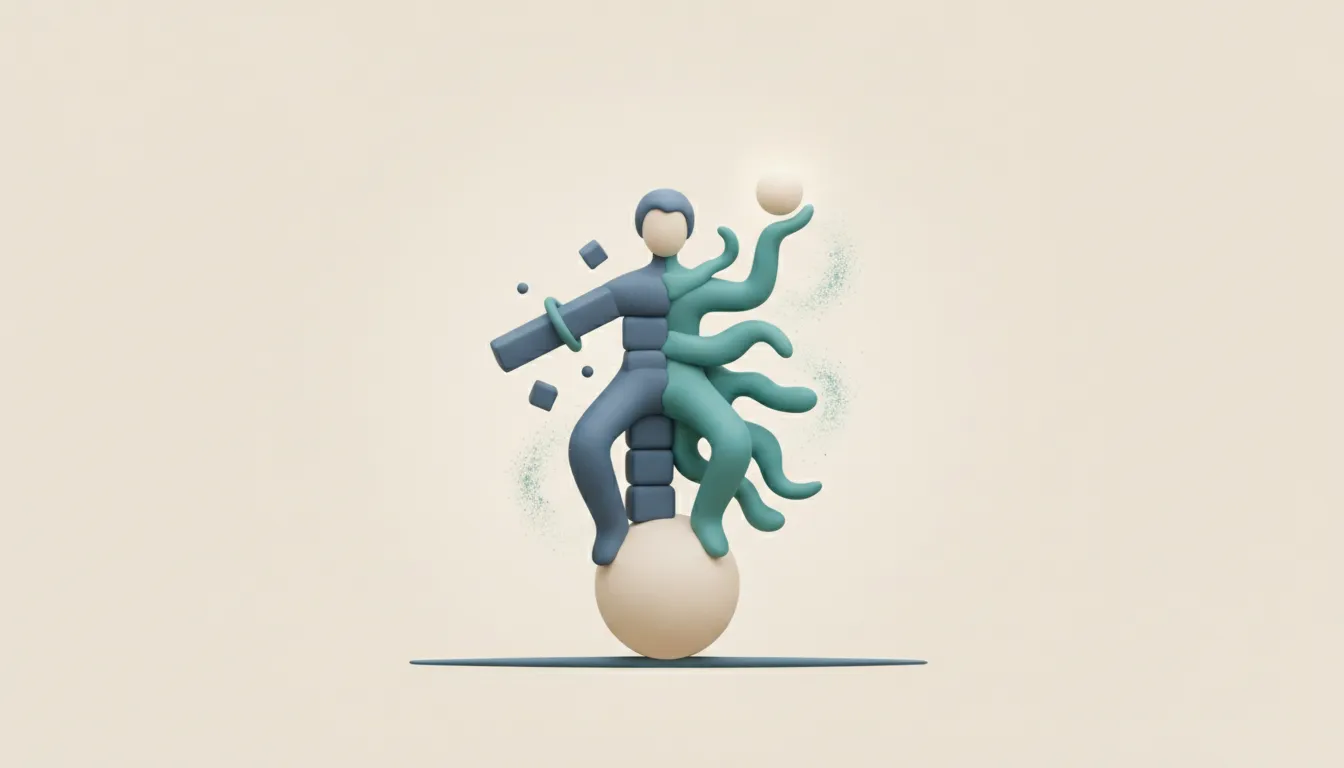
Why AuDHD Brains Oscillate Between Focus Modes

If you've ever found yourself locked into a task with terrifying intensity — only to have your attention ripped away by something entirely irrelevant, against your will — you're not experiencing inconsistency. You're experiencing two neurological networks staging a hostile takeover of each other.

FMRI research has illuminated a phenomenon unique to AuDHD: two competing network signatures running simultaneously. Autistic brains show hyper-connectivity within focused attention networks, particularly when processing high-interest tasks. This produces the deep lock-in that autistic people know well — the world narrows, time distorts, and the task becomes everything. ADHD brains, by contrast, show under-connectivity in the sustained attention networks, with a default mode network that refuses to quiet down, constantly broadcasting unrelated thoughts, environmental stimuli, and the sudden urgent conviction that you need to look up the migration patterns of Arctic terns right now.

Rommelse et al. (2017) identified shared genetic variants in dopamine and serotonin pathways affecting default mode network connectivity in co-occurring autism and ADHD. What this means in practice is that the AuDHD brain isn't simply combining two attention styles — it's running two competing architectures that alternately dominate, neither fully in control.

The dopamine paradox at the heart of this is worth understanding. Autistic reward circuits are highly selective: they accept specific, meaningful stimulation — the special interest, the deep dive, the pattern finally completing itself. ADHD circuits are non-selective and starving: they'll accept almost any stimulation just to bring dopamine to a bearable level. When these two systems coexist, you get a brain that swings between autistic lock-in (when the autistic reward system wins) and ADHD restless scanning (when ADHD urgency breaks through). Neither state is chosen. Both are neurologically authentic.

From the outside, observers see a person who 'can concentrate when they want to.' This is one of the most damaging misreadings of AuDHD. What they're seeing is not selective motivation or inconsistent effort — they're seeing the unpredictable outcome of two network states competing for dominance. You don't choose which system wins any more than you choose your heart rate.

The reframe that matters: this oscillation, as disruptive as it is to navigate, produces something neither neurotype achieves alone. The switch from autistic depth to ADHD breadth and back creates unexpected connections. Experts in their field who suddenly see the system from outside it. Artists who zoom in on texture then back out to structure. The tug-of-war is real — and it is also generative.

Why AuDHD People Build Then Abandon Systems

Somewhere in your life there is a beautiful, abandoned system. Maybe it's a colour-coded notebook with carefully designed sections you used for exactly eleven days. Maybe it's a productivity app with a three-tier tagging structure that took four hours to configure and was opened twice. Maybe it's a physical filing system that is now mostly a surface for other things.

This is not a character flaw. This is the AuDHD executive double-bind in action, and it is one of the most reliable features of this neurological profile.

Here is what happens. The autistic brain has a profound drive toward structure and predictability. In conditions of uncertainty or chaos, the autistic nervous system experiences genuine distress — the kind that motivates action. So the AuDHD person does what their autistic brain does brilliantly: they design a comprehensive, logical, beautifully organised system to impose order on the chaos. The planning phase is satisfying in exactly the way autistic brains find satisfying — pattern creation, rule-making, completeness.

Then the ADHD brain encounters the completed system. And here is the problem: the puzzle is solved. The novelty is gone. The system works, which means using it is now a routine task rather than a creative challenge. For the ADHD brain, which depends on novelty and interest to maintain engagement, a working system is intrinsically less compelling than a system that needs building. The dopamine that fuelled construction has nowhere to go once construction is complete.

What follows is a particular AuDHD grief: you watch your own infrastructure decay. The system still exists. You know it works. You built it yourself and can see its logic. But initiating its use requires overcoming ADHD initiation paralysis — starting a familiar, non-novel task with no urgency — while simultaneously overcoming autistic task-switching difficulty, because you were doing something else and now you have to stop. Two gatekeepers, both demanding justification you cannot provide.

The practical path forward is not more discipline — it's structural novelty. Systems that have variety built into them. Routines with choice points. Planners that change format weekly. Organisation systems where the maintenance itself contains enough variety to trigger ADHD engagement. The goal is not to make yourself use the perfect system. It's to design an imperfect system that your ADHD brain finds interesting enough to keep using.

The AuDHD Routine-Novelty Paradox

You want routine. You genuinely do. The predictability of knowing what comes next, the comfort of familiar sequences, the low cognitive load of not having to navigate new territory — your autistic nervous system finds these things genuinely regulating. Disruption to routine is not mere inconvenience; it activates real distress.

And you want novelty. Genuinely, urgently, neurologically. The new idea, the unexplored direction, the change of scene, the different approach — your ADHD brain requires these to maintain the dopamine levels that make engagement possible. Without novelty, routine becomes a kind of slow cognitive suffocation.

These are not contradictions. They are two valid, neurologically grounded needs — they simply don't naturally harmonise, and the environment rarely accommodates both simultaneously.

The neurochemistry involved is genuinely interesting. Serotonin, closely associated with autistic comfort needs, supports sameness, predictability, and low-arousal stability. Dopamine, the primary currency of ADHD motivation, is driven by novelty, surprise, and reward anticipation. The optimal states for each system pull in opposite directions: the autistic nervous system regulates best with serotonin-supporting sameness; the ADHD system activates best with dopamine-driving novelty. When both systems need regulating simultaneously, the person can find themselves apparently unable to make any choice — not because they're indecisive, but because every option violates one system's requirements.

From the outside, this looks like contradiction or confusion. People describe AuDHD individuals as 'hard to please' or 'inconsistent in what they want.' This framing is wrong and unhelpful. The person knows exactly what they want — they want routine AND novelty, predictability AND stimulation. The problem is that the environment usually offers one or the other.

The concept of structured novelty emerges from this understanding. Not random change (overwhelming to the autistic system) and not pure repetition (deadening to the ADHD system), but variation within predictable frameworks. The same breakfast, but a rotating menu within a fixed category. The same work time, but different tasks within an established structure. The same social format, but new content within familiar roles. This is not a compromise — it is the actual optimal state for an AuDHD nervous system, and building it deliberately is a legitimate life design strategy.

The AuDHD Social Energy Paradox

You arrive at a social gathering and something clicks. Someone mentions a topic that connects to three things you've been thinking about, and suddenly you're talking — fast, animated, enthusiastic, making connections out loud, asking follow-up questions before you've finished the previous ones. Your ADHD social drive is fully activated: the novelty of new conversation, the dopamine of engagement, the interest-fuelled momentum of a good exchange.

And then, sometimes mid-sentence, sometimes a few minutes later, the wall arrives.

The autistic nervous system has been processing the entire social environment in parallel the whole time: the sensory input of multiple conversations, the volume, the unpredictable turn-taking, the unspoken social rules requiring continuous monitoring, the effort of tracking tone and facial expression and what everyone's status relationship to everyone else is. This processing is not optional and it is not free. It runs at significant neurological cost, and when the cost has exceeded available resources, shutdown isn't a choice — it's a circuit breaker.

What makes AuDHD social dynamics particularly complex is the double masking load. Autistic individuals in social settings are typically masking autistic traits — suppressing stimming, monitoring communication style, tracking and meeting neurotypical social expectations. ADHD individuals are simultaneously managing impulsivity — the interrupting, the tangents, the volume control, the not saying the unexpected thing that just appeared in working memory. AuDHD individuals are doing both simultaneously, from the same finite executive resource pool. The cognitive overhead is measurable and it is higher than either condition requires alone.

The sudden disappearance that confuses people — the enthusiastic conversationalist who vanishes without apparent reason — is not rudeness, mood instability, or social rejection. It is the autistic nervous system executing an emergency resource allocation decision. The social engagement budget has been spent, and continuing would mean accessing reserves that don't exist.

Oxytocin and dopamine interactions add another layer. Social bonding releases oxytocin, which the ADHD system finds genuinely rewarding. But the sensory and social processing demands of extended interaction deplete the dopamine available for emotional regulation, making the experience increasingly costly even while it remains appealing. This is why the AuDHD person can simultaneously want to stay and need to leave — both responses are neurologically accurate.

Why AuDHD Focus Feels Like Roulette

On Tuesday, you wrote twelve thousand words without looking up. On Wednesday, you couldn't start a single paragraph. On Friday you were back, locked in, producing work that genuinely surprised you. The same person. The same task. The same desk. Different outcome every time.

This is not inconsistency as a character trait. This is trait fluctuation — the normal, predictable-in-its-unpredictability pattern of AuDHD attention, and it is one of the most reliable reasons for late diagnosis.

Autistic monotropic focus — the tendency to channel cognitive resources into a single interest or topic with great depth — is a genuine attention superpower when it aligns with what needs doing. When an AuDHD person's autistic interest focus is activated on a relevant task, the result is the kind of deep, sustained, high-quality output that makes neurotypicals ask what your secret is. The answer is that your autistic attention architecture just happened to align with something you're actually supposed to be doing.

But monotropism doesn't take requests. It activates on its own conditions — interest, meaning, pattern-recognition reward — not on the basis of external importance or deadlines. When monotropic focus is not activated, the ADHD system is the dominant driver, and it brings with it all the characteristic attention dysregulation: difficulty initiating, distraction from irrelevant stimuli, attention pulled by more interesting targets mid-task.

Antshel et al. (2016) documented compounded executive function challenges in AuDHD that exceed the sum of either condition alone. This compounding is visible in focus specifically: autistic task-switching difficulty (resistance to moving on from a focus state) combines with ADHD initiation paralysis (resistance to entering a focus state), creating a pattern where getting in and getting out of productive focus are both harder than they would be with either condition alone.

The 'inconsistency' label is one of the more damaging things that gets attached to AuDHD people. It implies unreliability of character when what's actually operating is neurological trait fluctuation. Clinicians who don't understand co-occurrence often read the variable presentation as 'subclinical' — not severe enough on any given day to meet criteria. This is why average AuDHD diagnosis comes significantly later than single-condition diagnosis. The conditions mask each other, and the fluctuation reads as stability.

Dual Network Conflict in AuDHD

Neuroimaging has given us a window into what makes AuDHD brains structurally distinct from either autism or ADHD alone. The picture that emerges is not of two conditions simply co-occurring — it is of two network architectures actively competing for control.

In autism, researchers consistently find hyper-connectivity within local neural networks — particularly those supporting detailed, focused processing. This means that when an autistic brain engages with a task, the relevant network activates with unusual intensity and maintains that activation. The flip side is reduced connectivity between distant brain regions, which is why task-switching and contextual flexibility can be harder.

In ADHD, the pattern is essentially the opposite: under-connectivity in the sustained attention networks, with a hyperactive default mode network that refuses to deactivate during task performance. The default mode — the network that generates mind-wandering, self-referential thought, and the impulse to check what time it is — should quiet down when you're trying to focus. In ADHD, it doesn't reliably do so.

In AuDHD, both patterns are present. The brain's sustained attention system is under-connected (ADHD signature), but when attention does lock in, it hyper-connects and becomes difficult to shift (autistic signature). The default mode is overactive at baseline (ADHD), but when specific interests are engaged, the whole attention architecture reroutes toward them with unusual intensity (autism). The result is a brain that swings between two extreme states rather than resting in a flexible middle.

Rommelse et al. (2017) identified that shared genetic variants in dopamine and serotonin pathways — particularly those regulating synaptic transmission in attention networks — underlie both conditions. This isn't coincidental co-occurrence. The same genetic architecture produces both network signatures, which is why 50-70% of autistic people also meet ADHD criteria. They share a root.

Practically, this means that attention interventions designed for one neurotype often partially work and partially backfire for AuDHD. Strategies that strengthen sustained attention (ADHD interventions) can intensify monotropic lock-in (autistic challenge). Strategies that support task-switching (autistic interventions) can remove the anchor that keeps ADHD attention on the right channel. Effective support has to account for both architectures simultaneously.

The AuDHD Dopamine Paradox

Dopamine is the brain's signal for 'this matters, pay attention, keep going.' It is the neurochemical backbone of motivation, focus, reward learning, and the ability to sustain effort on things that aren't immediately enjoyable. When dopamine signalling works typically, the brain can generate engagement with important tasks, build habits through reward association, and maintain motivation across the flat middle of any long project.

In ADHD, baseline dopamine is lower than typical. The ADHD brain is chronically under the threshold needed to engage sustained attention networks without external stimulation. This is why novelty, urgency, interest, and challenge activate ADHD brains reliably — they all produce dopamine surges that temporarily bring the system above threshold. Without these activators, the ADHD brain is essentially searching for any stimulus that will provide enough dopamine signal to function. It is, neurochemically, hungry.

In autism, the dopamine system operates differently in reward circuits. Rather than a generalised hunger for stimulation, the autistic dopamine system is highly selective. It responds intensely to specific stimuli — particularly those connected to special interests, meaningful patterns, or predictable environments — and generates significantly less reward signal for stimuli that don't meet its criteria. This selectivity is part of what creates special interest engagement (extremely high dopamine for the right input) and difficulty with routine tasks (very low dopamine for inputs that don't resonate).

Hartman et al. (2016) demonstrated that the dopaminergic profile in comorbid autism-ADHD is distinct from either condition alone — not simply an average of the two, but a unique configuration. The AuDHD dopamine system is simultaneously hungry (ADHD baseline deficit) and selective (autistic reward circuit specificity). It needs stimulation constantly and can only accept a narrow range of it.

The practical consequences of this are significant. Standard ADHD dopamine-boosting strategies — novelty, gamification, varying the environment — may not work if the novel elements don't meet autistic selectivity criteria. Standard autistic special interest engagement — leaning into deep focus on preferred topics — may not resolve the ADHD background hunger for general stimulation. The solution requires both: high-stimulation engagement within interest-specific domains, building dopamine from the autistic system while also satisfying ADHD novelty requirements. This is genuinely harder to engineer than either alone, and understanding why makes it less confusing and more tractable.

The Executive Double Bottleneck

Executive function is the set of cognitive processes that govern goal-directed behaviour: initiating tasks, switching between them, holding information in working memory, suppressing irrelevant impulses, and monitoring progress. When executive function works reliably, it is largely invisible — the brain handles task transitions and starts automatically, without conscious effort.

In ADHD, executive function fails at the entry point. Initiation is the primary bottleneck: starting a task, particularly a low-interest or routine task, requires overcoming a significant neurological barrier. The ADHD brain's dopamine-driven motivation system doesn't fire reliably for tasks that lack sufficient interest, urgency, or novelty. The person knows what needs doing. They cannot make themselves begin. This is not procrastination as moral failing — it is initiation paralysis as neurological phenomenon.

In autism, executive function fails at the exit point. Task-switching — the cognitive flexibility to disengage from a current activity and redirect to a new one — is significantly impaired in autistic profiles. Once engaged with a task, particularly one that has activated monotropic focus, redirecting requires overcoming genuine cognitive resistance. Interruption to a task in progress can be experienced as distressing, not merely inconvenient. The autistic brain, when focused, does not want to stop.

In AuDHD, both bottlenecks are active simultaneously. Beginning a new task requires defeating ADHD initiation paralysis (the entry gate refuses to open) while simultaneously disengaging from whatever is currently happening (the autistic exit gate also refuses to open). This double bottleneck is why AuDHD people can spend extended periods in a transition state: neither doing the task they need to start nor continuing the task they were doing. Both gates are locked from the inside.

Antshel et al. (2016) documented that executive function challenges in AuDHD exceed the sum of what either condition would predict independently — a compounding, not additive, effect. This compounding appears to result from the two bottlenecks interfering with each other's compensatory strategies. ADHD management strategies that use urgency to trigger initiation can overwhelm the autistic system's need for gradual transition. Autistic management strategies that use predictable task sequences can remove the novelty that ADHD needs to initiate engagement.

The double bottleneck is real, it is documented, and it is not a sign of insufficient effort. Understanding it reframes the experience: forty minutes staring at an email is not laziness. It is two neurological gates, both locked, with keys that don't work for each other.