Sensory Overload in Autism and ADHD
Sensory overload is not sensitivity in the colloquial sense. It is the nervous system genuinely running out of processing capacity. This guide covers what causes it, how it differs from anxiety and panic, and what recovery actually requires.
For our full guide to autism, including lived experiences, the neuroscience, and interactive empathy simulations, visit our comprehensive autism page.
When the world is simply too much
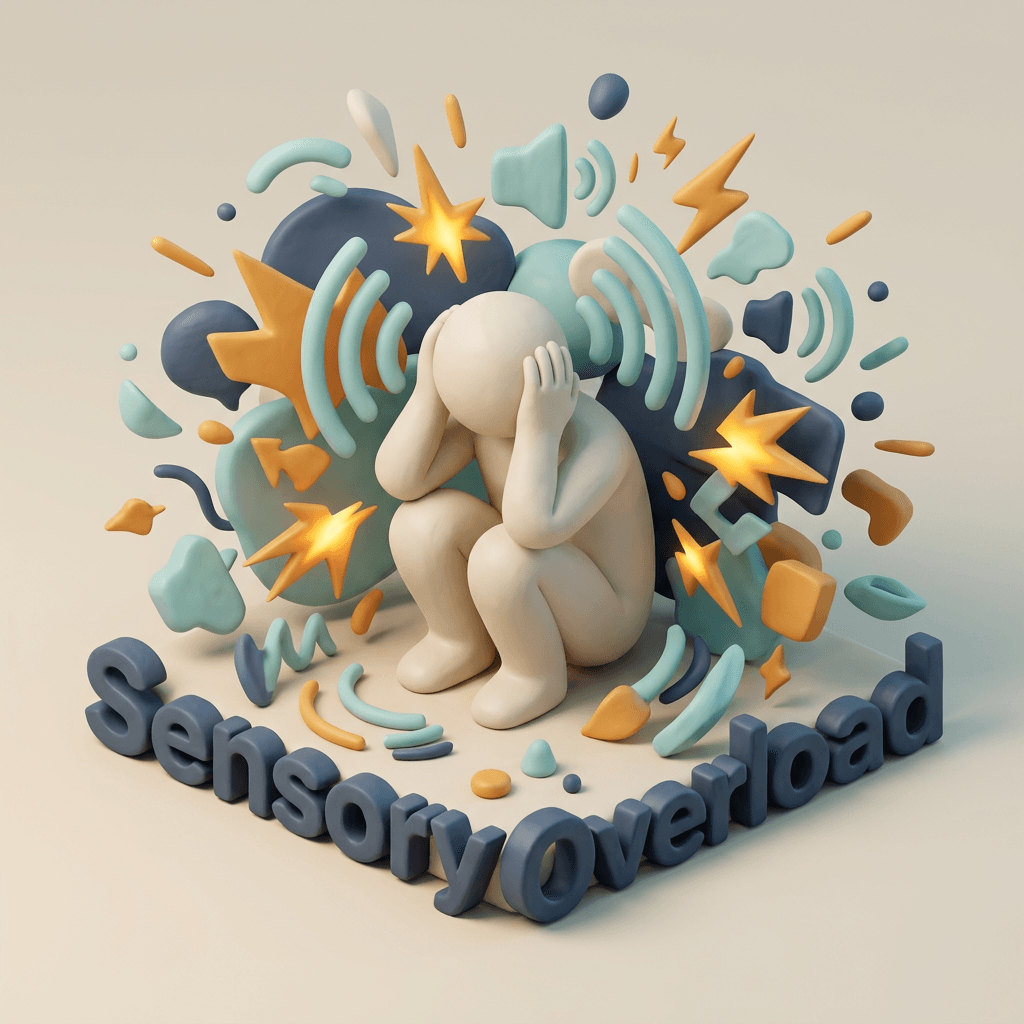
The fluorescent lights in the office. The colleague chewing. The phone notification sound every four minutes. For most people, this is background. For you, right now, it is everything: loud, bright, pressing, all at once, and you cannot find the off switch.
This is sensory overload. Not a preference, not a personality quirk, not "being sensitive" in the way the word is used dismissively. It is the nervous system genuinely running out of processing capacity, the neural equivalent of too many applications open at once and the whole machine slowing to a halt.
For autistic and ADHD adults, this is not an occasional bad day. It is a predictable consequence of nervous systems that process sensory input differently: more of it, less filtered, with fewer automatic mechanisms to decide what matters and what does not. The experience is real, neurologically grounded, and far more common than clinical literature reported even a decade ago.
If you have spent years being told to "just ignore it," or been given anxiety management strategies that never quite fit, or wondered why you need more recovery time than everyone around you seems to need, this guide is for you. It also connects to autism masking, because suppressing sensory reactions in public is one of the most exhausting forms of masking there is.
What is actually happening in the brain
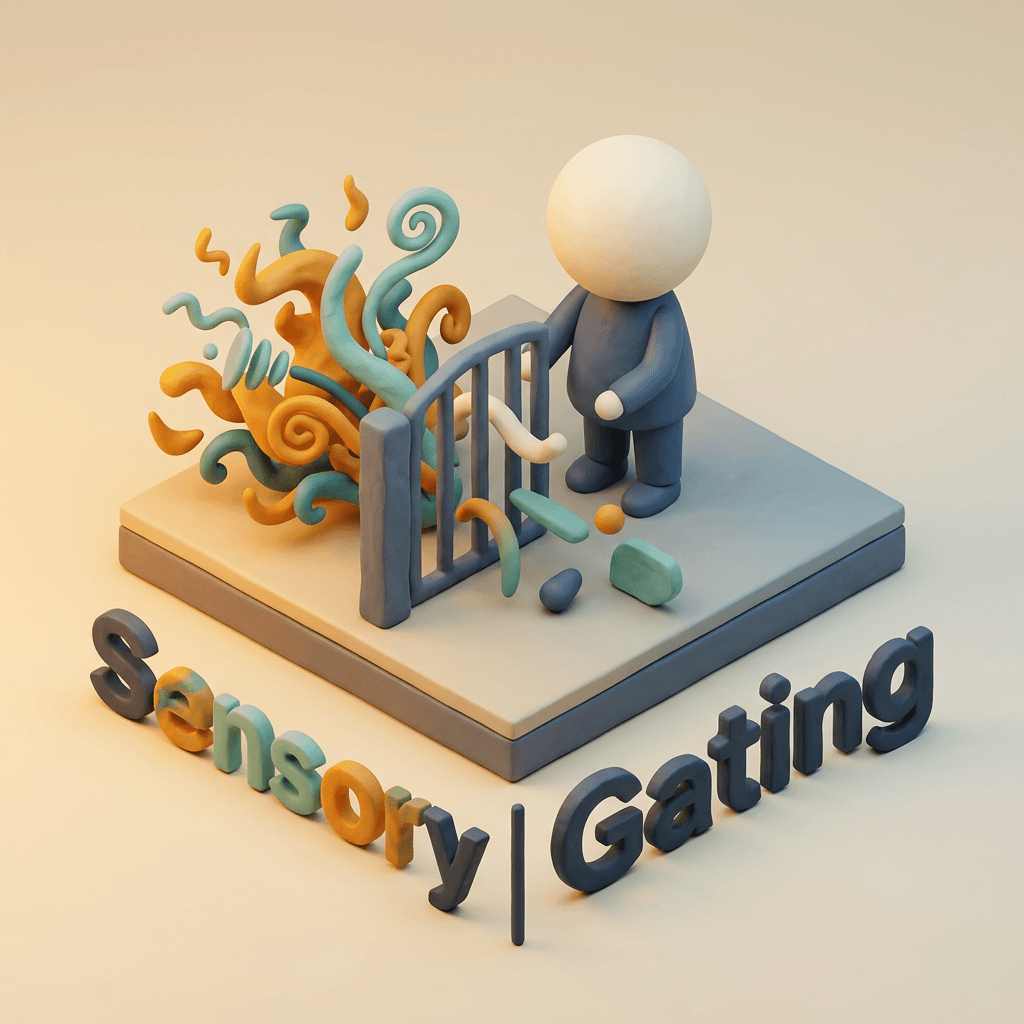
The nervous system does not passively receive sensory input. It actively filters it. A process called sensory gating decides, below the level of conscious awareness, which signals get through to conscious processing and which get suppressed as irrelevant noise. In a typical nervous system, the hum of an air conditioner is filtered out within seconds. Traffic noise fades. The feeling of your clothes against your skin disappears from attention.
Research by Marco et al. (2011) suggests that in many autistic brains, this gating mechanism is less consistent. More raw sensory data reaches conscious processing. The traffic noise does not fade. The clothing texture does not disappear. The air conditioner hum stays present and active. The input is not louder or brighter in an objective sense. It is simply less filtered, meaning the brain must actively process stimuli that other nervous systems discard automatically.
This is cognitively expensive. Processing more sensory data requires more attentional resources. In low-demand environments, this may be manageable, or even beneficial (many autistic people report noticing details others miss). In high-demand environments, supermarkets, open-plan offices, busy streets, the load exceeds capacity, and the system begins to fail. That is the phenomenology of overload: not metaphor, but a genuine processing ceiling being hit.
The 2013 revision to DSM-5 added sensory processing differences explicitly to the autism diagnostic criteria under criterion B4, covering both hypersensitivity and hyposensitivity. Adults who received diagnoses under DSM-IV, or who were assessed by clinicians who did not ask about sensory experience, may have an autism diagnosis without ever having been told that their sensory experiences were part of the clinical picture.
Environments that overload and why

Triggers vary considerably between individuals. What overwhelms one autistic person may be entirely neutral for another, and the same person can find the same environment tolerable on a rested day and intolerable when already depleted. With that caveat, some environments are structurally high-load for sensory-sensitive nervous systems.
Open-plan offices
Multiple overlapping conversations, unpredictable interruptions, variable lighting, background keyboard noise, and no acoustic separation. Designed for visual management, not neurological comfort.
Supermarkets
Fluorescent lighting with perceptible flicker, background music, PA announcements, trolley noise, multiple smells from food and cleaning products, crowds, and unpredictable social demands at checkouts.
Public transport
Physical proximity to strangers (tactile input), engine noise, sudden loud sounds (announcements, brakes), unpredictable motion, limited ability to exit or reduce input.
Clothing and textures
Seams, tags, synthetic fabrics, tight waistbands, and certain fabric weights can produce sustained tactile input that cannot be filtered out. Many autistic adults restrict to a narrow range of comfortable clothing.
Food textures
Distinct from taste preference. Certain textures, mushrooms, slimy foods, mixed textures in the same bite, trigger a strong aversive response that is not psychological and is not "fussiness."
Unexpected touch
Touch that is self-initiated is usually tolerable. Touch that arrives without warning bypasses the anticipatory regulation that makes touch manageable. This is why unexpected hugs from acquaintances can feel distressing even from well-meaning people.
Bright sunlight and visual glare
High visual contrast and intensity without the ability to reduce input. Many autistic adults wear sunglasses indoors or in conditions others find comfortable. This is not affectation.
Overlapping conversations
The cocktail party effect, the ability to follow one voice in a noisy room, is less reliable in autism. Multiple simultaneous conversations create a processing bottleneck where all streams demand attention equally.
ADHD adds a particular complexity. Sensory seeking and sensory avoiding can both exist in the same person, sometimes for different modalities, sometimes for the same modality at different times. An ADHD nervous system may crave movement and loud music for regulation while simultaneously being overwhelmed by fluorescent lighting. Sensory processing is not uniform, even within an individual.
Sensory overload, meltdown, and panic attack: what is different
These three experiences can look similar from the outside and can cascade into each other. They have different causes, different trajectories, and respond to different interventions.
Sensory overload
- Builds under sustained sensory input load
- Cause: too much stimulus, not perceived danger
- Relieved by reducing sensory input
- May arrive without any cognitive trigger
- Recovery requires time and stimulus reduction
Meltdown
- Nervous system shutdown or overwhelm
- Often follows sustained overload or demand
- Not controllable, not a choice, not a tantrum
- May involve crying, shouting, or shutting down completely
- Recovery takes hours to days
Panic attack
- Builds from perceived threat (real or anticipated)
- Cause: fear response, not sensory load
- Relieved by safety reassurance and controlled breathing
- Usually peaks and passes within 20-30 minutes
- Cognitive techniques can interrupt the cycle
They interact in both directions. Overload can trigger a panic response, because sustained overwhelm activates threat systems even without a cognitive threat. Anxiety lowers the threshold for sensory overload, meaning an anxious autistic person will hit overload faster under the same environmental conditions as a calm one.
"Sensory overload is not a meltdown because you cannot cope. It is a meltdown because your nervous system has genuinely hit a ceiling that most nervous systems never reach."
AskSheldon clinical framing
This distinction matters clinically. CBT-based anxiety interventions, which work by reappraising perceived threat, will not address sensory overload, because there is no distorted appraisal to correct. The input is genuinely overwhelming the system. The intervention is environmental, not cognitive.
Ready to explore further?
Take a free screening, chat with Sheldon, or explore 30+ neurotypes in depth.
What the nervous system actually needs

Recovery from sensory overload is decompression, not distraction. The distinction is not subtle: distraction adds sensory input (a podcast, a phone, a conversation) to an already overloaded system. Decompression removes input and demand until the system can reset.
"Recovery is not distraction. It is decompression. The two feel similar and produce opposite outcomes."
AskSheldon clinical framing
Practical decompression follows a sequence: reduce the most aversive input first, then work inward. The sequence that works for most autistic and ADHD adults:
- 1. LightDim or remove overhead lighting first. A dark room or sunglasses immediately reduces one of the highest-load inputs.
- 2. SoundReduce or eliminate sound. Noise-cancelling headphones, silence, or a consistent low-frequency tone (brown noise) are more effective than music, which adds a processing demand.
- 3. DemandsNo conversation, no decisions, no tasks. Even questions require processing and extend the recovery window.
- 4. Touch and physical proximitySome autistic people find deep pressure (a weighted blanket, firm self-hug) calming. Others need no physical contact at all. Know your own profile.
- 5. TimeFor many autistic and ADHD adults, recovery from a significant overload episode takes hours, not minutes. Building this into planning, rather than expecting a 10-minute recovery and returning to a high-demand environment, is more effective than willpower.
Stimming, repetitive self-soothing movement such as rocking, hand-flapping, or humming, is neurologically effective. It is not a behaviour to suppress, redirect, or grow out of. For many autistic and ADHD people, stimming provides proprioceptive and vestibular input that helps regulate an overwhelmed nervous system. Suppressing it extends recovery time and adds the cognitive cost of masking on top of the cost of overload.
Environmental design and long-term regulation

The underlying neurology of sensory processing differences does not change. The daily impact can reduce substantially. The mechanisms are knowledge, environmental design, and self-advocacy, not endurance or exposure.
Identifying your sensory profile
Sensory sensitivity operates across multiple modalities: visual, auditory, tactile, olfactory, gustatory, proprioceptive (body position), vestibular (movement and balance), and interoceptive (internal body signals). Within each modality, you may be hypersensitive (too much input), hyposensitive (not enough), or both at different times or for different stimuli. Mapping your own profile is the foundation of useful environmental design.
An occupational therapist with sensory processing training can conduct a formal sensory profile assessment. Self-tracking, noting which environments deplete you fastest and which feel neutral or restorative, is also useful preliminary data.
Designing your environments
Home
- +Warm lighting (2700K) instead of cool white or fluorescent
- +Acoustic panels or rugs to reduce echo and reverb
- +Designated low-stimulus recovery spaces
- +Weighted blankets and preferred textures
- +Organised visual fields to reduce ambient visual noise
Work
- +Noise-cancelling headphones as a standard accommodation
- +Private or low-stimulus workspace options
- +Defined break times and spaces
- +Reduced meeting load and asynchronous communication options
- +Advance notice for changes to routine or environment
Self-advocacy scripts
Communicating sensory needs in advance reduces the demand of in-the-moment negotiation (which itself adds cognitive load when you are already managing input). Some practical framings:
Workplace meeting rooms
"I find fluorescent lighting significantly more draining than warm lighting. Is it possible to use lamps or reduce the overhead lights in meeting spaces I use regularly? It is a formal access need, not a preference."
Social events
"I tend to need a quiet space to decompress during longer gatherings. It is not that I am not enjoying it. Is there somewhere low-stimulus I can use if I need to step away for 20 minutes?"
Medical or clinical appointments
"I have sensory sensitivities that are part of my autism and can make clinical environments difficult. Bright overhead lights and waiting room noise are the main issues. Is there anything that can be adjusted, or can I wait somewhere quieter?"
A note on desensitisation
Accommodation reduces sensory load. Desensitisation attempts to train the nervous system to tolerate a stimulus through repeated exposure. These are not equivalent approaches. For neurologically-based sensory sensitivity, forced desensitisation does not change the underlying processing differences and can cause significant distress and trauma. The correct intervention is accommodation and environmental design, not graduated exposure to aversive stimuli.
An occupational therapist trained in sensory integration may use sensory activities to improve regulation and expand the window of tolerance over time. This is distinct from forcing exposure. The approach is paced, consensual, and builds regulatory capacity, not compliance with discomfort.
Frequently asked questions
Is sensory overload the same as anxiety?
No, though they often co-occur. Anxiety is driven by perceived threat, activating the HPA axis. Sensory overload is driven by excessive sensory input overwhelming the nervous system's processing capacity. In practice they interact: anxiety lowers the threshold for sensory overload, and sensory overload can trigger anxiety. They respond to different interventions.
Can you get sensory overload without being autistic?
Yes. Sensory sensitivity and overload occur across many neurological profiles: ADHD, PTSD, migraine, chronic fatigue syndrome, and fibromyalgia. Being highly sensitive is not an autism-exclusive trait. Autism involves a broader pattern of sensory, social-communication, and repetitive-behaviour differences, not just sensory sensitivity.
Why do certain sounds, textures, or lights feel unbearable?
Research by Marco et al (2011) suggests many autistic brains have differences in sensory gating, the neural process that filters out irrelevant input. In typical processing, the brain automatically dampens background noise and sensation. In autism and ADHD, this filtering is less consistent, meaning more raw sensory data reaches conscious processing. The input is not louder or brighter; it is less filtered.
How do I recover from sensory overload?
The nervous system needs stimulus reduction, not distraction. Effective recovery: reduce input (dimmed lights, quiet space, reduced physical contact), reduce demand (no conversation, no decisions, minimal movement), and allow time. For many autistic and ADHD adults, recovery takes hours, not minutes. Stimming, repetitive self-soothing movement, is neurologically effective and not something to suppress.
Are there medications for sensory overload?
No approved medications target sensory processing specifically. Some autistic people find that ADHD stimulant medication improves sensory regulation as a secondary effect. Anxiety medications can reduce threshold effects. The main interventions are environmental design and occupational therapy, specifically sensory integration approaches.
Can I ever get less sensitive over time?
The underlying neurology stays. The daily impact can reduce significantly with knowledge (understanding your own sensory profile), environmental design (reducing ambient sensory load at home and work), self-advocacy (communicating needs in advance), and reducing the additional cognitive load of masking.
What is a sensory diet?
An occupational therapy term for a personalised plan of sensory activities, including proprioceptive input, vestibular movement, and deep pressure, that help regulate a sensory-sensitive nervous system throughout the day. Not a food plan, an activity plan developed with an OT familiar with sensory processing.
Ready to explore further?
Take a free screening, chat with Sheldon, or explore 30+ neurotypes in depth.
Built by neurodivergent minds. 30+ conditions explored. Always free.
Sources
- Marco, E. J., et al. (2011). Sensory processing in autism: A review of neurophysiologic findings. Pediatric Research, 69(5 Pt 2), 48R-54R.
- Green, S. A., et al. (2019). Sensory processing difficulties in autism spectrum disorder: a Delphi review. Frontiers in Psychology, 10, 1168.
- American Psychiatric Association (APA). (2022). Diagnostic and Statistical Manual of Mental Disorders, Fifth Edition, Text Revision (DSM-5-TR). American Psychiatric Publishing.