الحساسية المتداخلة (Synesthesia) | AskSheldon
الحساسية المتداخلة (Synesthesia)

ما هو التزامن الحسي؟

Synesthesia is a natural variation in brain wiring where stimulation of one sense (like hearing) automatically activates another (like vision). It is not a disorder, but a different way of perceiving reality—one that is richer and more interconnected.

1 in 25أشخاص متأثرون
4%الانتشار
نطاق ذكاء طبيعي

كيف يظهر التزامن الحسي؟

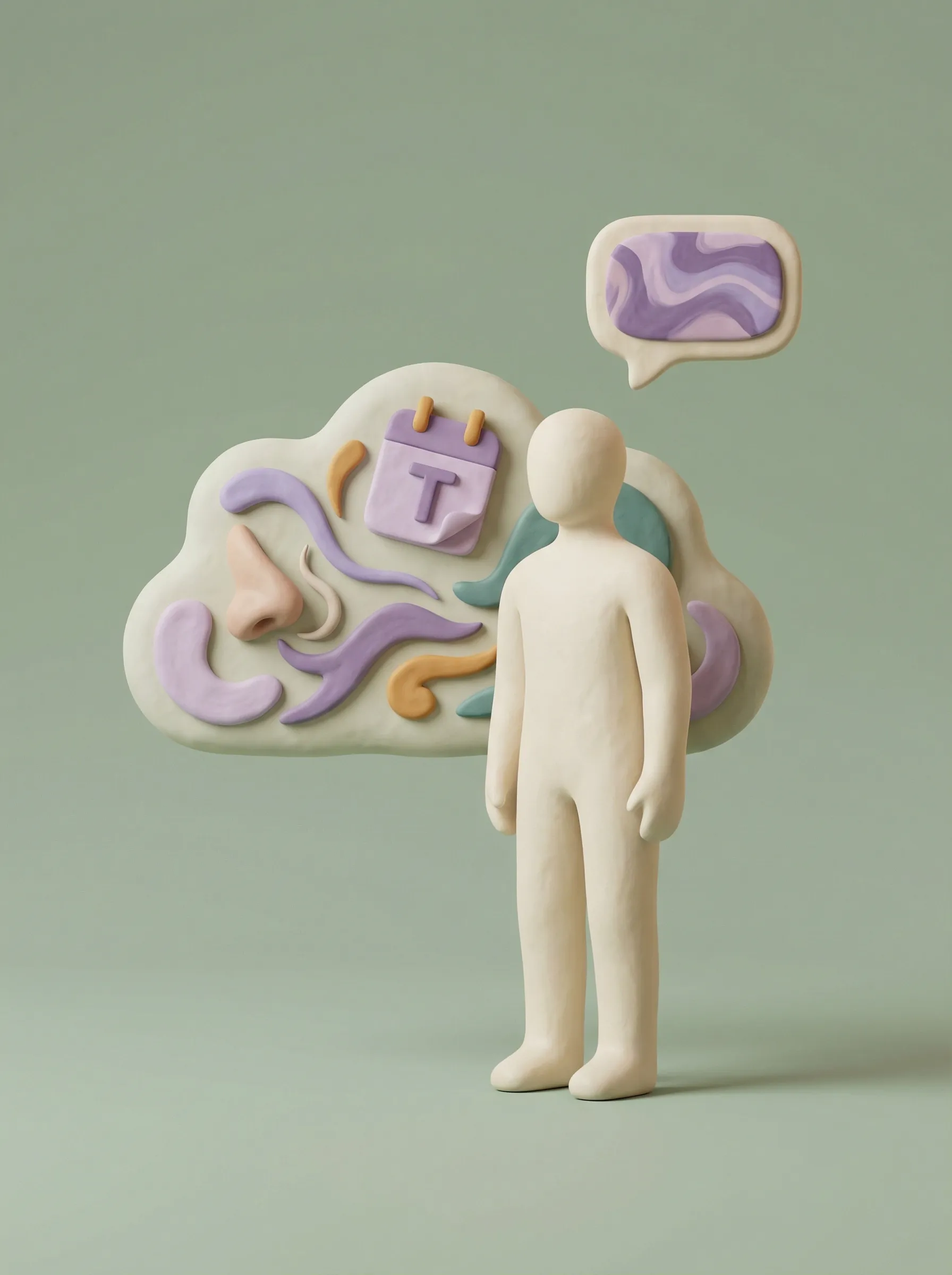
  • Describing sensory combinations others don't share: 'Thursdays smell purple'
  • Strong reactions when sensory pairings feel 'wrong' — like a number printed in the 'wrong' color
  • Unusual memory feats: recalling phone numbers by their color patterns
  • Navigating time by gesturing at invisible spatial landmarks
  • Maintaining the same sensory associations for decades without variation

أنواع التزامن الحسي

  • Grapheme-Colour(~65%)
  • Chromesthesia(~20%)
  • Spatial Sequence(~10%)
  • Lexical-Gustatory(~3%)
  • Mirror-Touch(~2%)

أسئلة شائعة عن التزامن الحسي

Can you develop synesthesia later in life?

Most cases are lifelong, but rare

Is synesthesia a superpower?

While some experience enhanced memory/creativity, it

تمت مراجعة المحتوى وفق معايير DSM-5 والأدبيات السريرية الحالية. هذه الصفحة للأغراض التثقيفية ولا تُشكّل مشورة طبية. استشر مختصاً صحياً مؤهلاً للتشخيص أو العلاج.

الحساسية المتداخلة (Synesthesia)

الحساسية المتداخلة

هل يمكن أن يكون هذا أنا؟

الحساسية المتداخلة (Synesthesia)الصوت قريباً

نحن نُعِدّ دليلاً صوتياً لهذه الحالة. أخبرنا عند إطلاقه.

ما هي فعلاً؟

Synesthesia is a natural variation in brain wiring where stimulation of one sense (like hearing) automatically activates another (like vision). It is not a disorder, but a different way of perceiving reality—one that is richer and more interconnected.

إنها اختلاف في طريقة تركيب الدماغ، وليست عيباً في الشخصية.

تخمين سريع

كم شخصاً من بين 25 تظن أن لديه هذا؟

انقر على الأيقونات لتقديم تقديرك.

fMRI studies show measurable cross-activation of colour-processing regions in synesthetes when viewing black letters — confirming synesthesia is a genuine neurological phenomenon, not imagination.

Neuron (Hubbard & Ramachandran, 2005)
Tap to Start Myth Busting

كيف تبدو من الخارج مقابل كيف تُحسّ من الداخل

التجربة المعاشة خلف السلوك الملاحَظ

Describing sensory combinations others don't share: 'Thursdays smell purple' — The Automatic Color
اضغط للرؤية من الداخل

ما يراه الآخرون

Describing sensory combinations others don't share: 'Thursdays smell purple'

The Automatic Color
اضغط للعودة

من الداخل

The Automatic Color

When I hear music, colors appear. When I read words, tastes surface. These aren't metaphors—they're involuntary perceptions I can't turn off.

Strong reactions when sensory pairings feel 'wrong' — like a number printed in the 'wrong' color — The Wrong Signal
اضغط للرؤية من الداخل

ما يراه الآخرون

Strong reactions when sensory pairings feel 'wrong' — like a number printed in the 'wrong' color

The Wrong Signal
اضغط للعودة

من الداخل

The Wrong Signal

That 'A' is printed in blue but it IS red. The mismatch creates genuine discomfort, like hearing a chord played with one note off.

Unusual memory feats: recalling phone numbers by their color patterns — The Memory Palace
اضغط للرؤية من الداخل

ما يراه الآخرون

Unusual memory feats: recalling phone numbers by their color patterns

The Memory Palace
اضغط للعودة

من الداخل

The Memory Palace

Numbers have colors, so phone numbers become color sequences I can photograph mentally. My recall isn't effort—it's vision.

Navigating time by gesturing at invisible spatial landmarks — The Spatial Calendar
اضغط للرؤية من الداخل

ما يراه الآخرون

Navigating time by gesturing at invisible spatial landmarks

The Spatial Calendar
اضغط للعودة

من الداخل

The Spatial Calendar

Months and years exist in 3D space around me. I navigate time like a landscape, pointing to where 'March' lives.

Maintaining the same sensory associations for decades without variation — The Consistency
اضغط للرؤية من الداخل

ما يراه الآخرون

Maintaining the same sensory associations for decades without variation

The Consistency
اضغط للعودة

من الداخل

The Consistency

My associations never change. What was true at age 5 remains true now. This reliability is what separates it from imagination.

Becoming overwhelmed in chaotic sensory environments others tolerate — The Overload Risk
اضغط للرؤية من الداخل

ما يراه الآخرون

Becoming overwhelmed in chaotic sensory environments others tolerate

The Overload Risk
اضغط للعودة

من الداخل

The Overload Risk

Too many stimuli and my senses flood with layered data. Beauty tips into overwhelm when every input triggers three others.

Grapheme-colour synesthetes outperform matched non-synesthetes on memory for letter and number sequences — automatic multi-sensory encoding creates genuine recall advantages.

Psychological Science (Yaro & Ward, 2007)
Tap to Start Myth Busting

Types of الحساسية المتداخلة (Synesthesia)

Grapheme-Colour: Letters and numbers have inherent colours. The 3 is green, the A is red — not by choice but by neural wiring. It's as automatic and consistent as seeing the colour of a traffic light.
النوع 1~65%

Grapheme-Colour

Letters and numbers have inherent colours. The 3 is green, the A is red — not by choice but by neural wiring. It's as automatic and consistent as seeing the colour of a traffic light.

Letters/numbers trigger specific colours
Highly consistent over time
Most common form
Enhanced memory for text
Chromesthesia: Sounds trigger visual experiences — colours, shapes, textures that float or pulse in sync with the music. A C-major chord might be floating gold triangles. This isn't metaphor; it's perception.
النوع 2~20%

Chromesthesia

Sounds trigger visual experiences — colours, shapes, textures that float or pulse in sync with the music. A C-major chord might be floating gold triangles. This isn't metaphor; it's perception.

Sound triggers visual experiences
Music creates complex visual landscapes
Often correlates with musical talent
Consistent sound-to-vision mapping
Spatial Sequence: Time, numbers, and sequences exist in 3D space around your body. Days of the week have positions, years form shapes. You can literally point to where Thursday lives.
النوع 3~10%

Spatial Sequence

Time, numbers, and sequences exist in 3D space around your body. Days of the week have positions, years form shapes. You can literally point to where Thursday lives.

Time/numbers exist in 3D space
Days and months have positions
Often enhances calendar memory
Strong spatial reasoning
Lexical-Gustatory: Words evoke specific tastes. 'Tuesday' might taste like chicken soup. It's not association — it's automatic, involuntary activation of your gustatory cortex by language input. The rarest common type.
النوع 4~3%

Lexical-Gustatory

Words evoke specific tastes. 'Tuesday' might taste like chicken soup. It's not association — it's automatic, involuntary activation of your gustatory cortex by language input. The rarest common type.

Words trigger specific tastes
Automatic and involuntary
Rarest common form
Can make some words unpleasant
Mirror-Touch: Observing someone being touched activates your own somatosensory cortex. You physically feel what others feel — not metaphorically. Your mirror neuron system has extra direct lines to sensation.
النوع 5~2%

Mirror-Touch

Observing someone being touched activates your own somatosensory cortex. You physically feel what others feel — not metaphorically. Your mirror neuron system has extra direct lines to sensation.

Observing touch activates own sensation
Heightened mirror neuron activity
Often correlates with high empathy
Can be overwhelming in crowds

Synesthesia affects approximately 4% of the population — around 300 million people worldwide. It appears rare mainly because most synesthetes never realise their perception is unusual.

Neuropsychologia (Simner et al., 2006)
Tap to Start Myth Busting

علم SYNESTHESIA

The "Why" Behind the "What"

ليس الأمر خيالاً، بل هو علم الأعصاب.

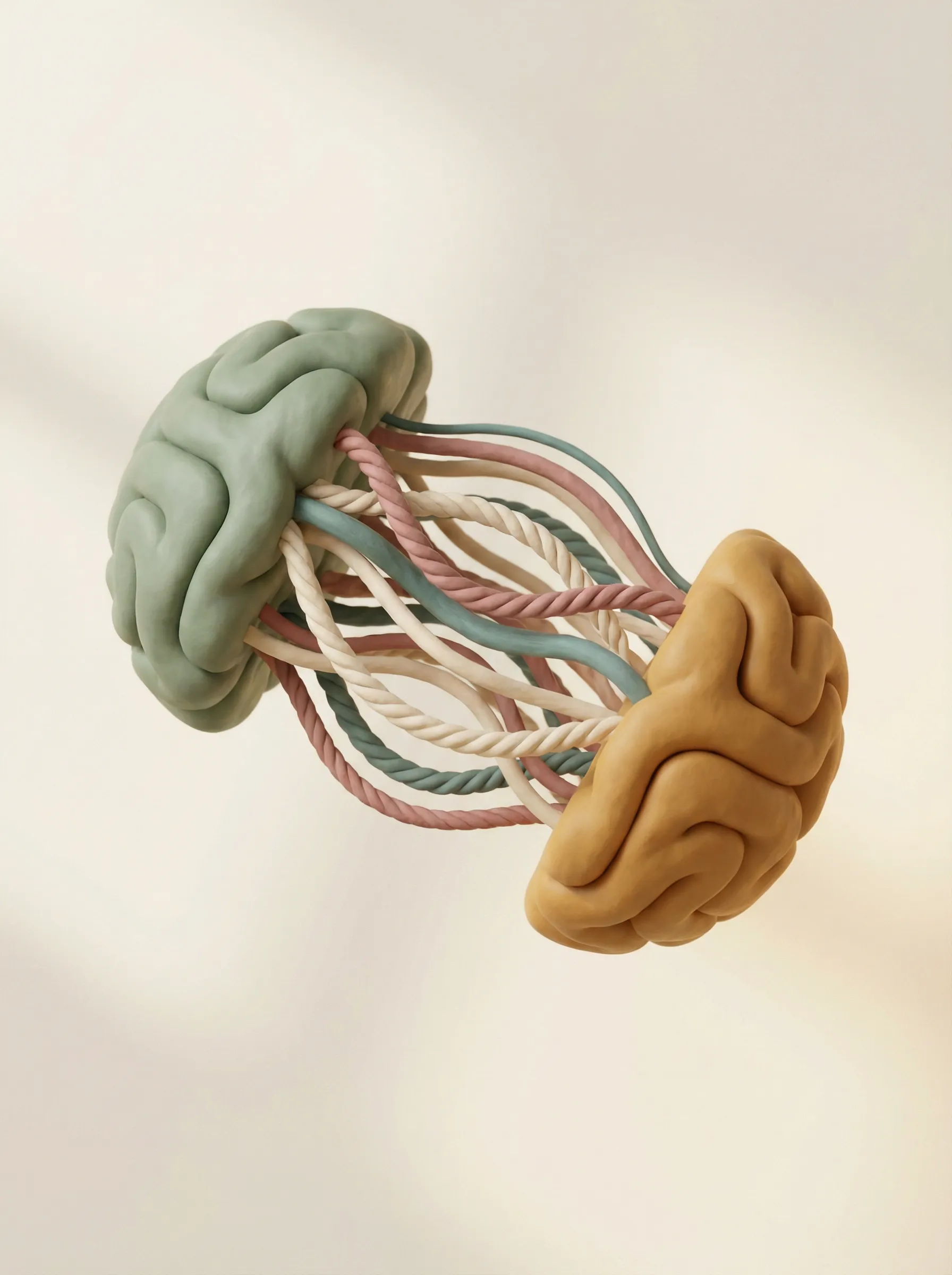
الدماغ المتصل: خلال مراحل نمو الطفل، تُقلّص معظم الأدمغة الروابط بين مناطق القشرة الحسية. لكن دماغك احتفظ بعدد أكبر منها. والنتيجة هي تنشيط متبادل حرفي: منطقتان حسيتان تُطلقان إشاراتهما في وقت واحد، في كل مرة.
التنشيط المتبادل

الدماغ المتصل

خلال مراحل نمو الطفل، تُقلّص معظم الأدمغة الروابط بين مناطق القشرة الحسية. لكن دماغك احتفظ بعدد أكبر منها. والنتيجة هي تنشيط متبادل حرفي: منطقتان حسيتان تُطلقان إشاراتهما في وقت واحد، في كل مرة.

اختبار الموثوقية: تتجاوز نسبة اتساق نتائج الاختبارات المتكررة لدى المصابين بالاستشعار المتزامن 90% على مدى سنوات، وهي نسبة أعلى بكثير من نسبة اتساقها لدى غير المصابين الذين يحاولون تذكر إجاباتهم السابقة. وهذا دليل علمي قاطع على أن هذه التجربة إدراكية وليست خيالية.
الاتساق الإدراكي

اختبار الموثوقية

تتجاوز نسبة اتساق نتائج الاختبارات المتكررة لدى المصابين بالاستشعار المتزامن 90% على مدى سنوات، وهي نسبة أعلى بكثير من نسبة اتساقها لدى غير المصابين الذين يحاولون تذكر إجاباتهم السابقة. وهذا دليل علمي قاطع على أن هذه التجربة إدراكية وليست خيالية.

الأسلاك الموروثة: تنتشر ظاهرة التوحد الحسي في العائلات. فالأقارب من الدرجة الأولى للأشخاص المصابين بالتوحد الحسي أكثر عرضةً للإصابة بها من عامة الناس. ويبدو أن الاختلافات الجينية التي تؤثر على تنظيم الإشارات العصبية والترابط بين الحواس المختلفة هي السبب الكامن وراء هذه الظاهرة.
علم الوراثة

الأسلاك الموروثة

تنتشر ظاهرة التوحد الحسي في العائلات. فالأقارب من الدرجة الأولى للأشخاص المصابين بالتوحد الحسي أكثر عرضةً للإصابة بها من عامة الناس. ويبدو أن الاختلافات الجينية التي تؤثر على تنظيم الإشارات العصبية والترابط بين الحواس المختلفة هي السبب الكامن وراء هذه الظاهرة.

الحديقة غير المقلمة: خلال مرحلة الطفولة، تُقلّص معظم أدمغة الأطفال الروابط العصبية بين المناطق الحسية، تمامًا كما تُقلم حديقة بحيث ينمو كل نبات في مكانه الخاص. لكن دماغك حافظ على نمو هذه الروابط بين أماكن النمو. والنتيجة ليست فوضى عشوائية، بل حديقة تتلاقح فيها الأزهار، مُنتجةً تراكيب لا يُمكن أن تُنتجها حدائق ذات أحواض منفردة. إنها أكثر ثراءً وترابطًا، وقد تكون مُذهلة أحيانًا عندما تتفتح جميع الأزهار في آنٍ واحد.
الآليات

الحديقة غير المقلمة

خلال مرحلة الطفولة، تُقلّص معظم أدمغة الأطفال الروابط العصبية بين المناطق الحسية، تمامًا كما تُقلم حديقة بحيث ينمو كل نبات في مكانه الخاص. لكن دماغك حافظ على نمو هذه الروابط بين أماكن النمو. والنتيجة ليست فوضى عشوائية، بل حديقة تتلاقح فيها الأزهار، مُنتجةً تراكيب لا يُمكن أن تُنتجها حدائق ذات أحواض منفردة. إنها أكثر ثراءً وترابطًا، وقد تكون مُذهلة أحيانًا عندما تتفتح جميع الأزهار في آنٍ واحد.

Linked to reduced neural pruning during childhood, resulting in persistent cross-activation between sensory cortical regions.

Synesthetes show test-retest consistency above 90% over years on colour-letter mappings — compared to below 40% for people asked to fake or memorise associations.

Cortex (Baron-Cohen et al., 1993)
Tap to Start Myth Busting
Restricted Access

Scientific Deep Dive

Explore Myths to Unlock

Earn 5 Insight Points

Illustration for Deep Dive fact 1
1 / 15

Am I hallucinating these colors?

No, you

Unlock Answer
Two Sides of the Coin

وجها العملة

كل اختلاف عصبي يأتي مع نقاط ضعف. السمة نفسها التي تسبب الكفاح في سياق واحد تخلق براعة في سياق آخر.

Sensory Overload

Multi-channel input means multi-channel overwhelm. A noisy room isn't just loud — it's a simultaneous visual storm. You're processing more than everyone else in the room, with no opt-out.

Colour Conflict

When real-world colours clash with synesthetic ones, the cognitive friction is genuine and persistent. A logo, a name in the wrong font colour, a mismatch between expectation and reality — it creates low-grade perceptual discomfort that's hard to explain.

Medical Dismissal

Describing your perception honestly — saying the number 7 is green, or that music has shapes — and being told you're imagining it, attention-seeking, or metaphorising leaves a particular kind of mark. Especially when you're a child.

First-degree relatives of synesthetes have synesthesia at rates more than 10x the population prevalence, confirming a strong genetic component involving neural connectivity genes.

Journal of Neurogenetics (Asher et al., 2009)
Tap to Start Myth Busting

أصوات المجتمع

تجارب حقيقية

Tuesdays are yellow, and 7 is a bossy little number. I thought everyone saw the world in color.

Community Member
22

I can

Community Member
39

My memory is photographic because I associate every fact with a texture and a hue.

Community Member
16

Explaining synesthesia is like trying to describe a new color. You just have to feel it.

Community Member
33

I use my

Community Member
50

The world is never boring. Even a blank wall has a hum and a shade.

Community Member
27

تظن أن لديك الحساسية المتداخلة (Synesthesia)؟

خذ تقييم الفحص بالجودة السريرية. يستغرق أقل من 5 دقائق ويمنحك رؤى فورية.

إعادة البرمجة للنجاح

توقف عن محاولة إصلاح نفسك. ابدأ في بناء نظام دعم يتوافق مع دماغك لا يعارضه.

Therapy

  • Sensory Integration Therapy
    OT-led approaches to managing multi-sensory input and reducing overload in environments that activate multiple synesthetic channels simultaneously.
  • Acceptance-Based CBT
    Frameworks for accepting unusual perceptual experiences without distress, and for communicating them to others without self-censorship.
  • Somatic Therapy for Mirror-Touch
    Body-centred approaches to managing somatosensory activation from observed touch — particularly useful in high-contact or crowded environments.

Medication

  • No direct pharmacological treatment
    Synesthesia is not a disorder requiring medication. If anxiety or sensory overload are significant, standard anxiety management approaches apply.
  • Anxiety support for overload
    For synesthetes whose overload response involves significant anxiety, SSRIs or beta-blockers may be considered with a GP for the anxiety component specifically.

Lifestyle

  • Sensory Environment Design
    Curate workspaces with reduced auditory chaos to limit chromesthetic overload. Muted palettes reduce grapheme-conflict across the visual field.
  • Use Your Memory System
    Deliberately engage synesthetic associations in study and memory work. Colour-code by synesthetic associations, not arbitrary systems.
  • Strategic Seating
    In crowded or acoustically complex environments, position yourself to control your field of view and auditory exposure — particularly important for chromesthetes and mirror-touch synesthetes.
  • Music as a Regulatory Tool
    For chromesthetes, chosen music creates a known visual environment. Using familiar music during focused work creates a stable, predictable visual field rather than random environmental noise.

Supplements

  • No specific synesthesia supplements
    There are no supplements specifically targeting synesthesia. General neurological support (omega-3, magnesium, adequate sleep) applies as for any neurodivergent brain.
  • Magnesium for overload
    Magnesium glycinate may support nervous system regulation and reduce the anxiety component of sensory overload episodes (consult a doctor).

Environment

  • Colour-Consistent Materials
    When possible, use text in colours consistent with your synesthetic associations. Conflict-free reading environments reduce processing friction and fatigue.
  • Acoustic Management
    Noise-cancelling headphones, chosen soundscapes, or silence reduce chromesthetic chaos in overstimulating environments.
  • Visual Field Control
    Reducing the visual complexity of working environments limits the number of simultaneous grapheme-colour activations that compete for processing.
  • Informing Colleagues and Educators
    Equipping the people in your daily environment with accurate information about synesthesia prevents misinterpretation of conflict reactions and overload responses.

Body

  • Grounding for Mirror-Touch
    Physical grounding techniques (pressure, temperature, proprioception) help distinguish internally-activated touch sensations from external ones during overload.
  • Movement for Overload Recovery
    Physical movement helps process and discharge accumulated sensory input after overload episodes, particularly for chromesthetes and mirror-touch synesthetes.
  • Sensory Breaks
    Regular periods in low-stimulation environments — quiet, visually simple spaces — allow synesthetic channels to reset between high-demand periods.
  • Sleep as Sensory Recovery
    Adequate sleep supports overall sensory regulation. Sleep deprivation amplifies synesthetic intensity and lowers overload thresholds in many synesthetes.

أدوات لدماغك

مبنية لهذا النوع العصبي — وليست رفاهية عامة

عرض الكل
FAQ

الأسئلة الشائعة

مسرد المصطلحات

الحالات المتزامنة

حالات التباين العصبي كثيراً ما تسير معاً. فهم التزامن يساعد في بناء صورة كاملة.

انقر على أي حالة لمزيد من المعلومات. نسب التزامن مستقاة من أبحاث محكّمة.

المراجع العلمية

  1. Cytowic, R. E., & Eagleman, D. M. (2011). Wednesday Is Indigo Blue: Discovering the Brain of Synesthesia. MIT Press.
  2. Hubbard, E. M., & Ramachandran, V. S. (2005). Neurocognitive mechanisms of synesthesia. Neuron, 48(3), 509-520.
  3. Simner, J., et al. (2006). Synaesthesia: The prevalence of atypical cross-modal experiences. Perception, 35(8), 1024-1033.
  4. Baron-Cohen, S., et al. (1993). Coloured speech perception: Is synaesthesia what happens when modularity breaks down? Perception, 22(4), 419-426.
  5. Asher, J. E., et al. (2009). A whole-genome scan and fine-mapping linkage study of auditory-visual synesthesia reveals evidence of linkage to chromosomes 2q24, 5q33, 6p12, and 12p12. American Journal of Human Genetics, 84(2), 279-285.
  6. Ward, J. (2013). Synesthesia. Annual Review of Psychology, 64, 49-75.
  7. Yaro, C., & Ward, J. (2007). Searching for Shereshevskii: What is superior about the memory of synaesthetes? Quarterly Journal of Experimental Psychology, 60(5), 681-695.
  8. UK Synaesthesia Association. (2024). What is synaesthesia? https://www.uksynaesthesia.com/

Your world is richer than most will ever know.

لقد صمدت حتى الآن. تخيّل ما يمكنك فعله حين تتوقف عن محاربة دماغك.

Why Synesthetic Perception Is Not Imagination

When someone with grapheme-colour synesthesia tells you that the number 7 is green, they are not describing an aesthetic preference, a metaphor, or a memory from childhood. They are reporting a genuine perceptual experience that happens automatically, involuntarily, and with remarkable consistency every single time they encounter that number.

This is the part that confuses most people: synesthesia is not a choice. You cannot decide to stop seeing A as red any more than you can decide to stop seeing the sky as blue. The experience is pre-cognitive — it happens before conscious thought has a chance to intervene. This is what distinguishes genuine synesthesia from simple association or imagination. An association is something you can notice or not notice, summon or dismiss. A synesthetic percept arrives on its own terms, unbidden, every time.

The scientific evidence for this is substantial. Test-retest studies — where synesthetes are asked to report their pairings years apart, without warning or preparation — show consistency rates above 90%. If someone is making this up or confabulating rich associations, you would not see that level of accuracy. Neuroimaging studies, including fMRI and EEG, show measurable cross-activation: when a grapheme-colour synesthete sees the letter A, the visual cortex areas responsible for colour perception activate, even when the letter itself is presented in black. This is physical, measurable, real.

Living with a perceptual experience that most people around you do not share creates a particular kind of social complexity. Many synesthetes spend years — sometimes decades — assuming that everyone sees the same things. It simply doesn't occur to them that their experience is unusual, because it is so automatic and so consistently present that it feels like basic reality. When they discover that other people's A is just... black, or just a shape, the revelation can be genuinely disorienting.

There is also the question of what to say to people. Describing synesthetic perception to someone who doesn't experience it often produces skepticism, dismissal, or the frustrating suggestion that you're imagining things or seeking attention. The person describing it is not confused. Their nervous system is doing something measurably different. The challenge is explaining an extra sensory channel to someone who has never had access to that channel.

  • Synesthetic perception is automatic and involuntary — it cannot be switched off by choice or effort.
  • Test-retest consistency above 90% across years proves the experience is not confabulation or imagination.
  • fMRI shows physical cross-activation of colour-processing regions when synesthetes see letters — this is measurable neuroscience.
  • Many synesthetes spend years not realising their perception is unusual, because it feels like basic reality.

Synesthetic Conflict: When the World Gets the Colours Wrong

Imagine if every time you saw a stop sign, it was bright blue. Not just surprising — genuinely uncomfortable. A persistent low-level wrongness that you cannot tune out or rationalise away, because the mismatch isn't aesthetic, it's perceptual. This is something like what a grapheme-colour synesthete experiences when they encounter the word 'orange' printed in blue ink, or a company logo whose name has a clear colour but whose visual branding uses a different one entirely.

This is sometimes called synesthetic conflict or the synesthetic Stroop effect, and it's one of the most rigorous experimental tools for verifying synesthesia. In the classic Stroop test, neurotypical people are slower to name the ink colour of a word when the word itself names a different colour — for example, saying 'red' when the word RED is printed in blue. Synesthetes show a dramatically enhanced version of this effect, because they're experiencing a conflict not just between word meaning and ink colour, but between the word's synesthetic colour and the ink colour. Two competing colour signals, processed simultaneously, creating genuine perceptual friction.

For grapheme-colour synesthetes, this kind of conflict appears regularly in daily life in ways that can be difficult to explain to others. Certain names feel wrong because the person's hair is the wrong colour for their name. Certain brand logos create discomfort because the logo colour doesn't match the colour of the brand name's letters. Reading text in colours that conflict with the synesthetic colours of the letters takes measurably longer and feels actively uncomfortable.

This is not pickiness, hypersensitivity in a pejorative sense, or an aesthetic preference. It is the predictable consequence of having an additional perceptual channel that is involuntarily activated and that sometimes produces signals conflicting with the external world. The cognitive friction is real, measurable in reaction time studies, and not something the synesthete can simply choose to ignore.

Understanding this helps reframe what can look like disproportionate reactions to minor things. The logo isn't just a design choice that someone dislikes. It is a stimulus that is triggering two conflicting perceptual signals simultaneously, every time it is seen.

  • Synesthetic conflict occurs when an external colour clashes with a synesthetic colour — producing genuine perceptual friction, not aesthetic preference.
  • The synesthetic Stroop effect is measurable in reaction time studies and is one of the main scientific tools for verifying synesthesia.
  • Conflict between synesthetic and real-world colours slows processing and creates persistent discomfort that cannot be rationalised away.
  • What looks like an oversensitive reaction to branding or colour choices often reflects a real perceptual mismatch with an extra sensory channel.

How Synesthesia Enhances Memory

Memory works better when information is encoded across multiple sensory channels. This is why memory champions use techniques like the method of loci — attaching information to vivid spatial and sensory imagery — to store and retrieve extraordinary amounts of data. Synesthetes, through no particular effort or technique, are already doing a version of this with every word, number, and sound they encounter.

For a grapheme-colour synesthete, a phone number isn't just a sequence of abstract digits. It's a colour sequence — a palette with a particular character, rhythm, and sometimes emotional tone. The number 7395 might be a journey from lime green through dark navy to ochre and then back to something clean and pale. This encoding happens automatically. The synesthete doesn't have to deliberately attach a colour mnemonic to the number. The cross-activation does it for them.

Research comparing synesthetes to matched non-synesthetes on standardised memory tasks consistently finds that synesthetes outperform on tasks involving the synesthetic domains. Grapheme-colour synesthetes show significantly enhanced memory for strings of letters and numbers. Spatial sequence synesthetes show enhanced memory for temporal information — dates, schedules, sequences of events. Chromesthetes often show heightened musical memory. The enhancement is domain-specific: the extra encoding hook only helps where it's applied.

What's particularly interesting is that this memory advantage is largely automatic. Synesthetes don't need to deliberately invoke a mnemonic technique. The extra layer of encoding is built into their perceptual system. Every letter they read has its colour. Every number in a sequence contributes its hue to the pattern. The result is that certain types of information — particularly the kinds of sequential, symbol-based information that synesthetic associations attach to — leave richer, more retrieval-friendly traces in memory.

This doesn't mean synesthetes have universally superior memories — the advantage is specific to domains where their particular synesthetic associations are active. But within those domains, the multi-sensory encoding that synesthesia produces creates a genuine and measurable memory advantage. The brain is doing extra work at the encoding stage that pays off at the retrieval stage.

  • Synesthesia creates automatic multi-sensory encoding — information is tagged with colour, texture, or spatial position without deliberate effort.
  • Research consistently shows domain-specific memory advantages in synesthetes — enhanced recall for letters, numbers, sequences, or music depending on type.
  • The memory benefit is automatic, not a learned technique — the extra encoding layer is built into the perceptual system.
  • This is the neurological basis for the 'number as colour gradient' experience — each digit contributes a sensory tag that aids retrieval.

Spatial Sequence Synesthesia: When Time Has a Location

For most people, the days of the week are an abstract sequence — a mental list that exists somewhere in conceptual space without any particular physical character. For people with spatial sequence synesthesia, it's different. Tuesday has a location. It might be slightly to the right and at shoulder height. Thursday might be further away, at a slight diagonal. The months of the year might form an oval or a ribbon that wraps around the body in a specific configuration, always oriented the same way, always with the same proportions between months.

This is not a metaphor or a habit of thought. It's a perceptual experience as consistent and automatic as any other synesthetic phenomenon. When asked to point to where 'last year' is, spatial sequence synesthetes will consistently gesture in a particular direction — and if asked again months later without warning, they'll gesture in the same direction. The spatial layout is stable.

Spatial sequence synesthesia extends beyond time. Numbers typically occupy positions along a line or curve that may twist, bend, or change angle at certain values. The number 10 might be at the end of a straight horizontal stretch; 11 might begin a new line heading in a different direction. Alphabet letters often have positions. Historical years and decades may form patterns that extend into the distance or wrap around in loops.

This means that temporal reasoning — figuring out how far apart two dates are, estimating durations, navigating schedules — involves literal spatial reasoning for spatial sequence synesthetes. They can navigate time by moving through a mental space rather than counting abstract units. This often produces advantages: scheduling and planning can be done visually by examining the space of the calendar layout; historical timelines can be recalled by walking through their mental spatial equivalent.

The challenge arises in environments where time is presented in abstract or linear formats that don't match the synesthete's internal spatial layout. Certain calendar apps, timeline representations, or scheduling formats may feel actively wrong — like being forced to navigate a familiar city using a map that has all the streets in the wrong places.

  • Spatial sequence synesthesia gives time, numbers, and sequences physical locations in 3D space — stable, consistent, and as automatic as any other percept.
  • Synesthetes can literally point to where 'last Tuesday' or 'next March' is — and will point to the same place when tested years later.
  • Temporal reasoning often involves spatial navigation for these synesthetes, which can create genuine advantages in planning and historical recall.
  • Calendar formats or timeline tools that don't match the internal spatial layout can feel actively disorienting or wrong.

Sensory Overload in Synesthesia: When More Becomes Too Much

For non-synesthetes, a noisy party is loud. Lots of simultaneous sound, competing conversations, music underneath it all. It can be tiring, particularly for introverts, but the primary channel of overload is auditory.

For a chromesthete — someone whose sounds trigger visual experiences — the same party is loud AND visually overwhelming simultaneously. Every voice produces its own colour or shape. The music creates shifting visual textures that pulse in time with the beat. The combination of multiple simultaneous sounds creates multiple simultaneous visual signals, all competing for processing. The party is not just auditory overload; it is a genuine multi-sensory event, happening across more channels than most people in the room are processing.

This is the hidden cost of multi-sensory encoding. The same connections that create richer perception in calm environments create richer chaos in chaotic ones. When input is complex, synesthetic input is even more complex, because every piece of sensory data spawns additional cross-modal responses. The synesthete is processing more.

For mirror-touch synesthetes in crowded environments, the overload dimension is somatic rather than visual. Every incidental bump, brush, or observed contact between other people activates sensory responses in the synesthete's own body. A crowded tube carriage or a busy market isn't just physically proximate — it's a continuous stream of tactile activations, experienced in the synesthete's own somatosensory cortex, without the contextual anchoring that comes from directly experiencing the touch.

Understanding this matters for how synesthetes and the people around them interpret overwhelm. Wanting to leave a party early, finding certain environments unbearably stimulating, or needing more recovery time than seems proportionate to the activity — these responses make complete sense when you understand that the synesthete is processing an objectively larger sensory load than non-synesthetes in the same room. The threshold for overload is lower because the input volume is genuinely higher.

  • Synesthetic overload is real: noisy environments produce multiple simultaneous cross-modal signals, not just the single auditory channel non-synesthetes experience.
  • Chromesthetes in loud spaces receive both auditory and visual overload simultaneously — the processing load is objectively higher than for non-synesthetes.
  • Mirror-touch synesthetes in crowds experience somatic activation from observed contacts — their body is registering input their skin is not receiving.
  • Disproportionate-seeming responses to stimulating environments often reflect a genuinely larger sensory load, not hypersensitivity as a personality trait.

التنشيط المتبادل: علم الأعصاب للإدراك الحسي المتداخل

The most widely accepted neurological explanation for synesthesia is cross-activation — the idea that in synesthetic brains, activity in one sensory processing region directly triggers activity in an adjacent sensory region, through connections that persist beyond the developmental pruning that most brains undergo.

In the case of grapheme-colour synesthesia, the relevant regions are particularly well-studied. The region of the temporal lobe that processes written letters and numbers (the visual word form area, sometimes called the grapheme area) sits in close anatomical proximity to V4 and V8, the cortical regions involved in processing colour. In most adult brains, these regions are functionally distinct — activating a letter doesn't significantly activate colour regions. In grapheme-colour synesthetes, it does. fMRI studies consistently show that when a synesthete reads a black letter, the colour-processing regions of their visual cortex activate in a way that doesn't happen for non-synesthetes reading the same letter.

This cross-activation is not subtle and it is not a statistical artefact. The signal in colour-processing cortex when a synesthete encounters a grapheme is measurably above baseline, measurably consistent across presentations, and measurably correlated with the specific colour the synesthete reports for that grapheme. The neuroscience matches the phenomenology.

The developmental story is also important. The human brain undergoes extensive synaptic pruning during childhood — a process of eliminating excess neural connections to refine and specialise brain circuits. This pruning is generally adaptive, allowing the brain to become more efficient by reducing cross-talk between specialised regions. The leading hypothesis for synesthesia is that this pruning is less complete in synesthetic brains, either because of genetic variants that affect pruning processes or because of differences in the timing or extent of development. The result is that connections between sensory regions that are eliminated in most brains remain functional in synesthetic brains, creating the anatomical substrate for cross-activation.

This is why synesthesia is considered a neurodevelopmental variant rather than a disorder or a learned skill. The architecture is different from early in life, not damaged or acquired later. The brain simply developed with more connections between certain sensory processing regions, and those connections do what connections always do — they carry signals.

  • يُظهر التصوير بالرنين المغناطيسي الوظيفي تنشيطًا قابلًا للقياس لقشرة معالجة الألوان (V4/V8) عندما يواجه الأشخاص المصابون بالاستشعار المتزامن الحروف - حتى لو تم عرضها بالحبر الأسود.
  • يُفسر التنشيط المتبادل سبب كون الإدراك الحسي المتزامن تلقائياً: فهو مدفوع بالاتصال الهيكلي، وليس بالارتباط الواعي.
  • من المرجح أن تنشأ ظاهرة التوحد الحسي من انخفاض عملية تقليم المشابك العصبية أثناء النمو، مما يترك روابط بين المناطق الحسية التي تتخلص منها معظم الأدمغة.
  • هذا نوع من أنواع التطور العصبي - حيث تطورت بنية الدماغ بشكل مختلف منذ المراحل المبكرة من الحياة، وليس اضطرابًا مكتسبًا لاحقًا.

التنشيط المتبادل: علم الأعصاب للإدراك الحسي المتداخل

The most widely accepted neurological explanation for synesthesia is cross-activation — the idea that in synesthetic brains, activity in one sensory processing region directly triggers activity in an adjacent sensory region, through connections that persist beyond the developmental pruning that most brains undergo.

In the case of grapheme-colour synesthesia, the relevant regions are particularly well-studied. The region of the temporal lobe that processes written letters and numbers (the visual word form area, sometimes called the grapheme area) sits in close anatomical proximity to V4 and V8, the cortical regions involved in processing colour. In most adult brains, these regions are functionally distinct — activating a letter doesn't significantly activate colour regions. In grapheme-colour synesthetes, it does. fMRI studies consistently show that when a synesthete reads a black letter, the colour-processing regions of their visual cortex activate in a way that doesn't happen for non-synesthetes reading the same letter.

This cross-activation is not subtle and it is not a statistical artefact. The signal in colour-processing cortex when a synesthete encounters a grapheme is measurably above baseline, measurably consistent across presentations, and measurably correlated with the specific colour the synesthete reports for that grapheme. The neuroscience matches the phenomenology.

The developmental story is also important. The human brain undergoes extensive synaptic pruning during childhood — a process of eliminating excess neural connections to refine and specialise brain circuits. This pruning is generally adaptive, allowing the brain to become more efficient by reducing cross-talk between specialised regions. The leading hypothesis for synesthesia is that this pruning is less complete in synesthetic brains, either because of genetic variants that affect pruning processes or because of differences in the timing or extent of development. The result is that connections between sensory regions that are eliminated in most brains remain functional in synesthetic brains, creating the anatomical substrate for cross-activation.

This is why synesthesia is considered a neurodevelopmental variant rather than a disorder or a learned skill. The architecture is different from early in life, not damaged or acquired later. The brain simply developed with more connections between certain sensory processing regions, and those connections do what connections always do — they carry signals.

  • يُظهر التصوير بالرنين المغناطيسي الوظيفي تنشيطًا قابلًا للقياس لقشرة معالجة الألوان (V4/V8) عندما يواجه الأشخاص المصابون بالاستشعار المتزامن الحروف - حتى لو تم عرضها بالحبر الأسود.
  • يُفسر التنشيط المتبادل سبب كون الإدراك الحسي المتزامن تلقائياً: فهو مدفوع بالاتصال الهيكلي، وليس بالارتباط الواعي.
  • من المرجح أن تنشأ ظاهرة التوحد الحسي من انخفاض عملية تقليم المشابك العصبية أثناء النمو، مما يترك روابط بين المناطق الحسية التي تتخلص منها معظم الأدمغة.
  • هذا نوع من أنواع التطور العصبي - حيث تطورت بنية الدماغ بشكل مختلف منذ المراحل المبكرة من الحياة، وليس اضطرابًا مكتسبًا لاحقًا.

الاتساق الإدراكي: المعيار العلمي للتداخل الحسي

One of the earliest and most persistent challenges facing synesthesia research was the sceptic's objection: how do you know they're not just making it up, or confabulating vivid associations from childhood? The answer, it turns out, is elegantly simple — you test them twice.

The consistency test is the foundational behavioural diagnostic for synesthesia. A researcher presents a synesthete with a large set of graphemes and records their reported colour associations. Months or years later — without warning, without the synesthete having any opportunity to rehearse — the same graphemes are presented again. Genuine synesthetes report the same colours with extraordinary reliability: test-retest consistency rates above 90% are consistently found in peer-reviewed studies. People asked to fake synesthesia, or people trying to memorise colour-letter associations without genuine cross-activation, score far lower — typically below 40% on the same tests.

This consistency is not just a pass/fail metric. It reflects something fundamental about the nature of the experience. Perceptual experiences are consistent because they are generated by stable neural hardware. The colour-processing response to a particular grapheme is consistent in a genuine synesthete because it is produced by stable cross-activation pathways — the same structural connections producing the same signal every time. Association-based responses, imagination-based responses, and deliberately memorised mappings are all much less consistent because they depend on memory retrieval, which is inherently variable.

The consistency finding has been replicated across multiple research groups, multiple populations, multiple synesthetic types, and multiple time intervals ranging from days to decades. In some longitudinal studies, the associations appear essentially fixed for life — a grapheme that was a particular shade of red in childhood is often the same shade of red in adulthood, decades later.

This is also why synesthesia researchers now use computer-based colour-matching paradigms alongside verbal reporting — they can measure not just whether the synesthete reports 'red' for A, but exactly which shade of red, with a precision that makes the consistency finding even more striking. The brain isn't just generating a rough category. It's generating a specific, stable perceptual response.

  • إن اتساق الاختبار وإعادة الاختبار بنسبة تزيد عن 90٪ على مدى سنوات هو الدليل السلوكي المعياري الذهبي على أن التجربة الحسية المتزامنة هي إدراكية وليست خيالية.
  • عندما يُطلب من غير المصابين بالحساسية الحسية التظاهر بأن لديهم حساسية حسية، فإن النتيجة تكون أقل من 40% في اختبارات الاتساق - الفجوة كبيرة ويمكن تكرارها بشكل موثوق.
  • يشير الاتساق على مدى عقود في الدراسات الطولية إلى أن بعض الارتباطات الحسية المتزامنة ثابتة بشكل أساسي مدى الحياة.
  • تُظهر نماذج مطابقة الألوان الحديثة أن الأشخاص الذين يعانون من التداخل الحسي لا يعيدون إنتاج فئات الألوان فحسب، بل يعيدون إنتاج درجات لونية محددة أيضًا - وتتطابق دقة الاستجابة مع دقة الإدراك الحقيقي.

علم الوراثة للتداخل الحسي: لماذا ينتشر في العائلات

If you have synesthesia, there is a meaningful probability that someone in your immediate family does too — though they may never have mentioned it, because it's only recently become widely known that synesthesia exists as a named and researched phenomenon rather than just an unusual personal quirk.

Family studies have consistently found that synesthesia clusters in families at rates far above population prevalence. In one of the most rigorous early studies, researchers found that more than 40% of first-degree relatives of synesthetes also had synesthesia — compared to approximately 4% in the general population. The pattern of inheritance doesn't follow a simple dominant or recessive Mendelian model, which suggests that multiple genes are involved and that the trait is influenced by a combination of genetic variants rather than a single mutation.

Genetic research into synesthesia has identified several candidate gene regions, including variants in genes involved in axonal growth and guidance — the biological processes that determine how neurons make connections during brain development. This aligns neatly with the cross-activation and reduced-pruning hypotheses: if the genes that govern how connections form and are eliminated during development differ in synesthetes, you would expect to see persistent cross-modal connectivity as an outcome.

It's worth noting that synesthesia is not evenly distributed across types within families. A family might have multiple synesthetes, but each family member might have a different type — one grapheme-colour, one spatial sequence, one chromesthete. This suggests that what is inherited is not a specific synesthetic association pattern, but rather a general predisposition toward cross-modal connectivity. The specific form that connectivity takes may depend on which sensory regions happen to be anatomically proximate and which develop the most persistent cross-connections in a given individual.

The genetic basis also matters for understanding synesthesia in the context of other neurodevelopmental traits. Synesthesia shows elevated co-occurrence with autism, ADHD, and high sensory sensitivity — all conditions with their own genetic architectures involving neural connectivity. The overlap suggests shared underlying mechanisms in how certain genotypes affect the development of neural wiring.

  • أكثر من 40% من أقارب الدرجة الأولى للأشخاص المصابين بالاستشعار المتزامن يعانون أيضاً من الاستشعار المتزامن - أي عشرة أضعاف نسبة انتشاره بين السكان.
  • إن نمط الوراثة معقد، ويشمل جينات متعددة، وليس متغيراً سائداً أو متنحياً واحداً.
  • تشمل الجينات المرشحة تلك المشاركة في توجيه المحاور العصبية - العمليات التي تحدد كيفية تشكل الروابط العصبية واستمرارها.
  • يبدو أن ما يتم توريثه هو استعداد عام للاتصال بين الحواس، وليس نمطًا حسيًا متزامنًا محددًا - فقد يكون لكل فرد من أفراد الأسرة نوع مختلف.

Why Synesthetic Perception Is Not Imagination

When someone with grapheme-colour synesthesia tells you that the number 7 is green, they are not describing an aesthetic preference, a metaphor, or a memory from childhood. They are reporting a genuine perceptual experience that happens automatically, involuntarily, and with remarkable consistency every single time they encounter that number.

This is the part that confuses most people: synesthesia is not a choice. You cannot decide to stop seeing A as red any more than you can decide to stop seeing the sky as blue. The experience is pre-cognitive — it happens before conscious thought has a chance to intervene. This is what distinguishes genuine synesthesia from simple association or imagination. An association is something you can notice or not notice, summon or dismiss. A synesthetic percept arrives on its own terms, unbidden, every time.

The scientific evidence for this is substantial. Test-retest studies — where synesthetes are asked to report their pairings years apart, without warning or preparation — show consistency rates above 90%. If someone is making this up or confabulating rich associations, you would not see that level of accuracy. Neuroimaging studies, including fMRI and EEG, show measurable cross-activation: when a grapheme-colour synesthete sees the letter A, the visual cortex areas responsible for colour perception activate, even when the letter itself is presented in black. This is physical, measurable, real.

Living with a perceptual experience that most people around you do not share creates a particular kind of social complexity. Many synesthetes spend years — sometimes decades — assuming that everyone sees the same things. It simply doesn't occur to them that their experience is unusual, because it is so automatic and so consistently present that it feels like basic reality. When they discover that other people's A is just... black, or just a shape, the revelation can be genuinely disorienting.

There is also the question of what to say to people. Describing synesthetic perception to someone who doesn't experience it often produces skepticism, dismissal, or the frustrating suggestion that you're imagining things or seeking attention. The person describing it is not confused. Their nervous system is doing something measurably different. The challenge is explaining an extra sensory channel to someone who has never had access to that channel.

Synesthetic Conflict: When the World Gets the Colours Wrong

Imagine if every time you saw a stop sign, it was bright blue. Not just surprising — genuinely uncomfortable. A persistent low-level wrongness that you cannot tune out or rationalise away, because the mismatch isn't aesthetic, it's perceptual. This is something like what a grapheme-colour synesthete experiences when they encounter the word 'orange' printed in blue ink, or a company logo whose name has a clear colour but whose visual branding uses a different one entirely.

This is sometimes called synesthetic conflict or the synesthetic Stroop effect, and it's one of the most rigorous experimental tools for verifying synesthesia. In the classic Stroop test, neurotypical people are slower to name the ink colour of a word when the word itself names a different colour — for example, saying 'red' when the word RED is printed in blue. Synesthetes show a dramatically enhanced version of this effect, because they're experiencing a conflict not just between word meaning and ink colour, but between the word's synesthetic colour and the ink colour. Two competing colour signals, processed simultaneously, creating genuine perceptual friction.

For grapheme-colour synesthetes, this kind of conflict appears regularly in daily life in ways that can be difficult to explain to others. Certain names feel wrong because the person's hair is the wrong colour for their name. Certain brand logos create discomfort because the logo colour doesn't match the colour of the brand name's letters. Reading text in colours that conflict with the synesthetic colours of the letters takes measurably longer and feels actively uncomfortable.

This is not pickiness, hypersensitivity in a pejorative sense, or an aesthetic preference. It is the predictable consequence of having an additional perceptual channel that is involuntarily activated and that sometimes produces signals conflicting with the external world. The cognitive friction is real, measurable in reaction time studies, and not something the synesthete can simply choose to ignore.

Understanding this helps reframe what can look like disproportionate reactions to minor things. The logo isn't just a design choice that someone dislikes. It is a stimulus that is triggering two conflicting perceptual signals simultaneously, every time it is seen.

How Synesthesia Enhances Memory

Memory works better when information is encoded across multiple sensory channels. This is why memory champions use techniques like the method of loci — attaching information to vivid spatial and sensory imagery — to store and retrieve extraordinary amounts of data. Synesthetes, through no particular effort or technique, are already doing a version of this with every word, number, and sound they encounter.

For a grapheme-colour synesthete, a phone number isn't just a sequence of abstract digits. It's a colour sequence — a palette with a particular character, rhythm, and sometimes emotional tone. The number 7395 might be a journey from lime green through dark navy to ochre and then back to something clean and pale. This encoding happens automatically. The synesthete doesn't have to deliberately attach a colour mnemonic to the number. The cross-activation does it for them.

Research comparing synesthetes to matched non-synesthetes on standardised memory tasks consistently finds that synesthetes outperform on tasks involving the synesthetic domains. Grapheme-colour synesthetes show significantly enhanced memory for strings of letters and numbers. Spatial sequence synesthetes show enhanced memory for temporal information — dates, schedules, sequences of events. Chromesthetes often show heightened musical memory. The enhancement is domain-specific: the extra encoding hook only helps where it's applied.

What's particularly interesting is that this memory advantage is largely automatic. Synesthetes don't need to deliberately invoke a mnemonic technique. The extra layer of encoding is built into their perceptual system. Every letter they read has its colour. Every number in a sequence contributes its hue to the pattern. The result is that certain types of information — particularly the kinds of sequential, symbol-based information that synesthetic associations attach to — leave richer, more retrieval-friendly traces in memory.

This doesn't mean synesthetes have universally superior memories — the advantage is specific to domains where their particular synesthetic associations are active. But within those domains, the multi-sensory encoding that synesthesia produces creates a genuine and measurable memory advantage. The brain is doing extra work at the encoding stage that pays off at the retrieval stage.

Spatial Sequence Synesthesia: When Time Has a Location

For most people, the days of the week are an abstract sequence — a mental list that exists somewhere in conceptual space without any particular physical character. For people with spatial sequence synesthesia, it's different. Tuesday has a location. It might be slightly to the right and at shoulder height. Thursday might be further away, at a slight diagonal. The months of the year might form an oval or a ribbon that wraps around the body in a specific configuration, always oriented the same way, always with the same proportions between months.

This is not a metaphor or a habit of thought. It's a perceptual experience as consistent and automatic as any other synesthetic phenomenon. When asked to point to where 'last year' is, spatial sequence synesthetes will consistently gesture in a particular direction — and if asked again months later without warning, they'll gesture in the same direction. The spatial layout is stable.

Spatial sequence synesthesia extends beyond time. Numbers typically occupy positions along a line or curve that may twist, bend, or change angle at certain values. The number 10 might be at the end of a straight horizontal stretch; 11 might begin a new line heading in a different direction. Alphabet letters often have positions. Historical years and decades may form patterns that extend into the distance or wrap around in loops.

This means that temporal reasoning — figuring out how far apart two dates are, estimating durations, navigating schedules — involves literal spatial reasoning for spatial sequence synesthetes. They can navigate time by moving through a mental space rather than counting abstract units. This often produces advantages: scheduling and planning can be done visually by examining the space of the calendar layout; historical timelines can be recalled by walking through their mental spatial equivalent.

The challenge arises in environments where time is presented in abstract or linear formats that don't match the synesthete's internal spatial layout. Certain calendar apps, timeline representations, or scheduling formats may feel actively wrong — like being forced to navigate a familiar city using a map that has all the streets in the wrong places.

Sensory Overload in Synesthesia: When More Becomes Too Much

For non-synesthetes, a noisy party is loud. Lots of simultaneous sound, competing conversations, music underneath it all. It can be tiring, particularly for introverts, but the primary channel of overload is auditory.

For a chromesthete — someone whose sounds trigger visual experiences — the same party is loud AND visually overwhelming simultaneously. Every voice produces its own colour or shape. The music creates shifting visual textures that pulse in time with the beat. The combination of multiple simultaneous sounds creates multiple simultaneous visual signals, all competing for processing. The party is not just auditory overload; it is a genuine multi-sensory event, happening across more channels than most people in the room are processing.

This is the hidden cost of multi-sensory encoding. The same connections that create richer perception in calm environments create richer chaos in chaotic ones. When input is complex, synesthetic input is even more complex, because every piece of sensory data spawns additional cross-modal responses. The synesthete is processing more.

For mirror-touch synesthetes in crowded environments, the overload dimension is somatic rather than visual. Every incidental bump, brush, or observed contact between other people activates sensory responses in the synesthete's own body. A crowded tube carriage or a busy market isn't just physically proximate — it's a continuous stream of tactile activations, experienced in the synesthete's own somatosensory cortex, without the contextual anchoring that comes from directly experiencing the touch.

Understanding this matters for how synesthetes and the people around them interpret overwhelm. Wanting to leave a party early, finding certain environments unbearably stimulating, or needing more recovery time than seems proportionate to the activity — these responses make complete sense when you understand that the synesthete is processing an objectively larger sensory load than non-synesthetes in the same room. The threshold for overload is lower because the input volume is genuinely higher.

التنشيط المتبادل: علم الأعصاب للإدراك الحسي المتداخل

The most widely accepted neurological explanation for synesthesia is cross-activation — the idea that in synesthetic brains, activity in one sensory processing region directly triggers activity in an adjacent sensory region, through connections that persist beyond the developmental pruning that most brains undergo.

In the case of grapheme-colour synesthesia, the relevant regions are particularly well-studied. The region of the temporal lobe that processes written letters and numbers (the visual word form area, sometimes called the grapheme area) sits in close anatomical proximity to V4 and V8, the cortical regions involved in processing colour. In most adult brains, these regions are functionally distinct — activating a letter doesn't significantly activate colour regions. In grapheme-colour synesthetes, it does. fMRI studies consistently show that when a synesthete reads a black letter, the colour-processing regions of their visual cortex activate in a way that doesn't happen for non-synesthetes reading the same letter.

This cross-activation is not subtle and it is not a statistical artefact. The signal in colour-processing cortex when a synesthete encounters a grapheme is measurably above baseline, measurably consistent across presentations, and measurably correlated with the specific colour the synesthete reports for that grapheme. The neuroscience matches the phenomenology.

The developmental story is also important. The human brain undergoes extensive synaptic pruning during childhood — a process of eliminating excess neural connections to refine and specialise brain circuits. This pruning is generally adaptive, allowing the brain to become more efficient by reducing cross-talk between specialised regions. The leading hypothesis for synesthesia is that this pruning is less complete in synesthetic brains, either because of genetic variants that affect pruning processes or because of differences in the timing or extent of development. The result is that connections between sensory regions that are eliminated in most brains remain functional in synesthetic brains, creating the anatomical substrate for cross-activation.

This is why synesthesia is considered a neurodevelopmental variant rather than a disorder or a learned skill. The architecture is different from early in life, not damaged or acquired later. The brain simply developed with more connections between certain sensory processing regions, and those connections do what connections always do — they carry signals.

التنشيط المتبادل: علم الأعصاب للإدراك الحسي المتداخل

The most widely accepted neurological explanation for synesthesia is cross-activation — the idea that in synesthetic brains, activity in one sensory processing region directly triggers activity in an adjacent sensory region, through connections that persist beyond the developmental pruning that most brains undergo.

In the case of grapheme-colour synesthesia, the relevant regions are particularly well-studied. The region of the temporal lobe that processes written letters and numbers (the visual word form area, sometimes called the grapheme area) sits in close anatomical proximity to V4 and V8, the cortical regions involved in processing colour. In most adult brains, these regions are functionally distinct — activating a letter doesn't significantly activate colour regions. In grapheme-colour synesthetes, it does. fMRI studies consistently show that when a synesthete reads a black letter, the colour-processing regions of their visual cortex activate in a way that doesn't happen for non-synesthetes reading the same letter.

This cross-activation is not subtle and it is not a statistical artefact. The signal in colour-processing cortex when a synesthete encounters a grapheme is measurably above baseline, measurably consistent across presentations, and measurably correlated with the specific colour the synesthete reports for that grapheme. The neuroscience matches the phenomenology.

The developmental story is also important. The human brain undergoes extensive synaptic pruning during childhood — a process of eliminating excess neural connections to refine and specialise brain circuits. This pruning is generally adaptive, allowing the brain to become more efficient by reducing cross-talk between specialised regions. The leading hypothesis for synesthesia is that this pruning is less complete in synesthetic brains, either because of genetic variants that affect pruning processes or because of differences in the timing or extent of development. The result is that connections between sensory regions that are eliminated in most brains remain functional in synesthetic brains, creating the anatomical substrate for cross-activation.

This is why synesthesia is considered a neurodevelopmental variant rather than a disorder or a learned skill. The architecture is different from early in life, not damaged or acquired later. The brain simply developed with more connections between certain sensory processing regions, and those connections do what connections always do — they carry signals.

الاتساق الإدراكي: المعيار العلمي للتداخل الحسي

One of the earliest and most persistent challenges facing synesthesia research was the sceptic's objection: how do you know they're not just making it up, or confabulating vivid associations from childhood? The answer, it turns out, is elegantly simple — you test them twice.

The consistency test is the foundational behavioural diagnostic for synesthesia. A researcher presents a synesthete with a large set of graphemes and records their reported colour associations. Months or years later — without warning, without the synesthete having any opportunity to rehearse — the same graphemes are presented again. Genuine synesthetes report the same colours with extraordinary reliability: test-retest consistency rates above 90% are consistently found in peer-reviewed studies. People asked to fake synesthesia, or people trying to memorise colour-letter associations without genuine cross-activation, score far lower — typically below 40% on the same tests.

This consistency is not just a pass/fail metric. It reflects something fundamental about the nature of the experience. Perceptual experiences are consistent because they are generated by stable neural hardware. The colour-processing response to a particular grapheme is consistent in a genuine synesthete because it is produced by stable cross-activation pathways — the same structural connections producing the same signal every time. Association-based responses, imagination-based responses, and deliberately memorised mappings are all much less consistent because they depend on memory retrieval, which is inherently variable.

The consistency finding has been replicated across multiple research groups, multiple populations, multiple synesthetic types, and multiple time intervals ranging from days to decades. In some longitudinal studies, the associations appear essentially fixed for life — a grapheme that was a particular shade of red in childhood is often the same shade of red in adulthood, decades later.

This is also why synesthesia researchers now use computer-based colour-matching paradigms alongside verbal reporting — they can measure not just whether the synesthete reports 'red' for A, but exactly which shade of red, with a precision that makes the consistency finding even more striking. The brain isn't just generating a rough category. It's generating a specific, stable perceptual response.

علم الوراثة للتداخل الحسي: لماذا ينتشر في العائلات

If you have synesthesia, there is a meaningful probability that someone in your immediate family does too — though they may never have mentioned it, because it's only recently become widely known that synesthesia exists as a named and researched phenomenon rather than just an unusual personal quirk.

Family studies have consistently found that synesthesia clusters in families at rates far above population prevalence. In one of the most rigorous early studies, researchers found that more than 40% of first-degree relatives of synesthetes also had synesthesia — compared to approximately 4% in the general population. The pattern of inheritance doesn't follow a simple dominant or recessive Mendelian model, which suggests that multiple genes are involved and that the trait is influenced by a combination of genetic variants rather than a single mutation.

Genetic research into synesthesia has identified several candidate gene regions, including variants in genes involved in axonal growth and guidance — the biological processes that determine how neurons make connections during brain development. This aligns neatly with the cross-activation and reduced-pruning hypotheses: if the genes that govern how connections form and are eliminated during development differ in synesthetes, you would expect to see persistent cross-modal connectivity as an outcome.

It's worth noting that synesthesia is not evenly distributed across types within families. A family might have multiple synesthetes, but each family member might have a different type — one grapheme-colour, one spatial sequence, one chromesthete. This suggests that what is inherited is not a specific synesthetic association pattern, but rather a general predisposition toward cross-modal connectivity. The specific form that connectivity takes may depend on which sensory regions happen to be anatomically proximate and which develop the most persistent cross-connections in a given individual.

The genetic basis also matters for understanding synesthesia in the context of other neurodevelopmental traits. Synesthesia shows elevated co-occurrence with autism, ADHD, and high sensory sensitivity — all conditions with their own genetic architectures involving neural connectivity. The overlap suggests shared underlying mechanisms in how certain genotypes affect the development of neural wiring.